
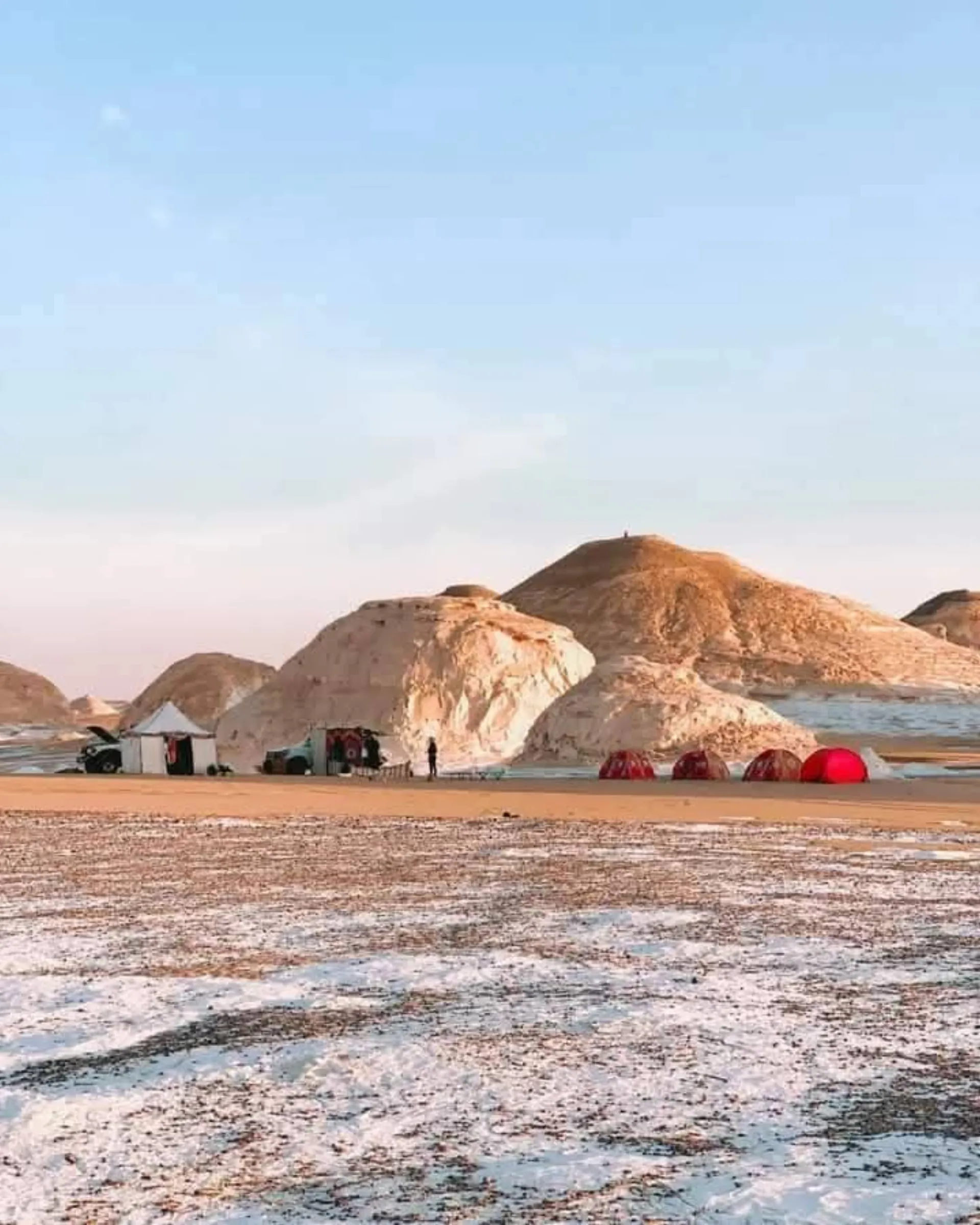
White Desert Safari — Egypt's Most Extraordinary Desert Experience
A White Desert safari is Egypt's most iconic desert experience. Set in the Farafra depression of Egypt's Western Desert, the White Desert (Sahara el Beyda) is a national park unlike anywhere else on Earth — where centuries of wind erosion have carved chalk into towering mushroom formations, inselbergs, and alien-white sculptures that glow silver under the moon. A White Desert safari takes you there: across the volcanic Black Desert, past the glittering Crystal Mountain, and deep into the chalk formations for a night of camping beneath one of the world's darkest, most star-filled skies.
What Is a White Desert Safari?
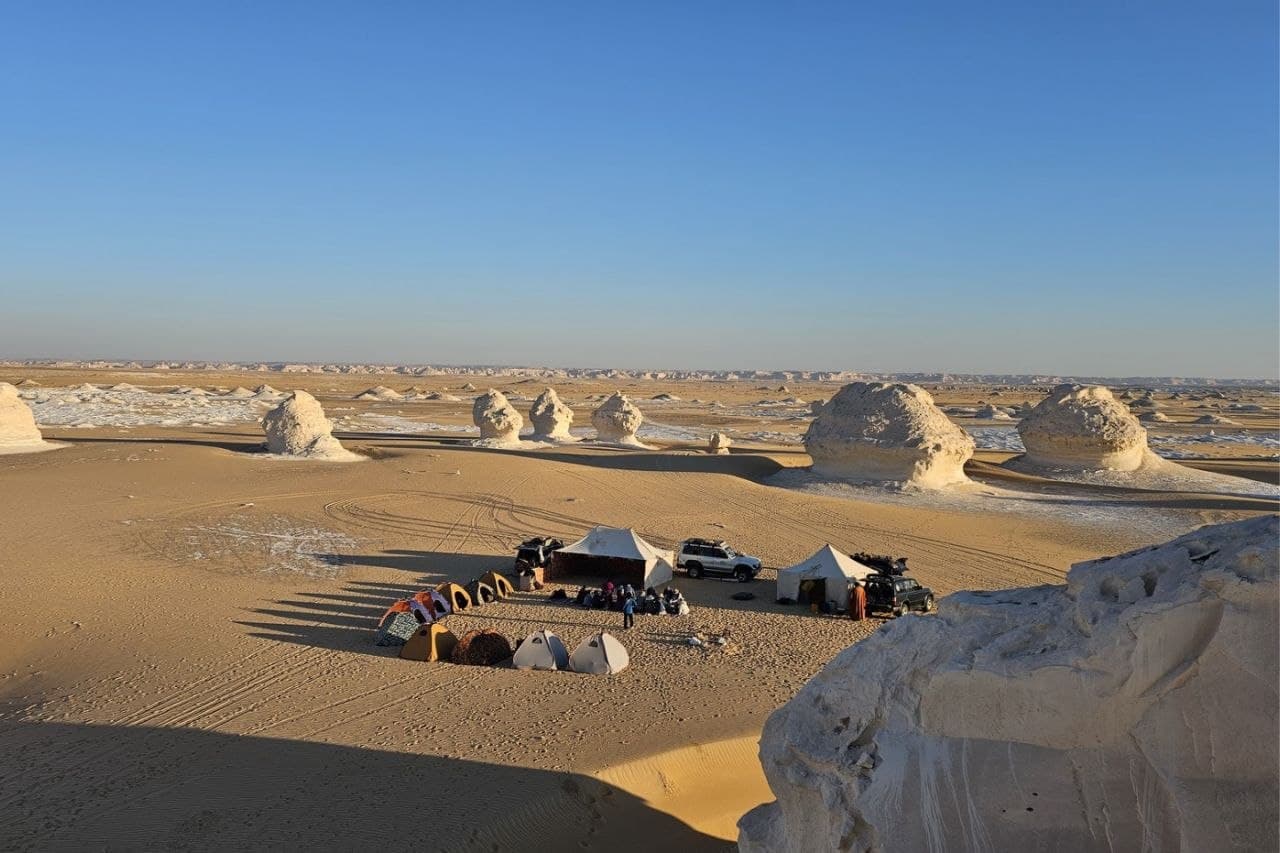
A White Desert safari is a guided desert expedition departing from Cairo or Giza, typically covering the Black Desert, Crystal Mountain, and the White Desert in a single journey. Most safaris are done in 4x4 vehicles driven by experienced Bedouin guides who know every track, formation, and hidden viewpoint in the desert. The experience almost always includes at least one overnight camping stay inside the national park — sleeping on mats under the open sky among the chalk sculptures, with a Bedouin-cooked meal and a fire to keep warm.
White Desert Safari Tour Options
1-Day White Desert Safari (Day Trip)
Depart Cairo at dawn, drive through the Black Desert and Crystal Mountain, spend the afternoon exploring the White Desert's chalk formations, and return to Cairo the same evening. A long but rewarding day — around 16 hours total. Best for travellers with limited time who still want to see the landscape.
2-Day White Desert Safari — Overnight (Most Popular)
The classic White Desert safari. Depart Cairo on the morning of day 1, spend the afternoon in the Black Desert and Crystal Mountain, then camp overnight in the White Desert. Wake up to sunrise among the chalk formations on day 2 before returning to Cairo. This is the most popular format — it gives you a full evening and morning in the desert, including stargazing, a campfire, and Bedouin-prepared meals.
3–5 Day White Desert Safari (Extended Expedition)
For deeper exploration, a multi-day White Desert safari extends into Jara Cave (prehistoric rock art), the Great Sand Sea, and Agabat Valley. Some itineraries add camel trekking or sandboarding. Multiple nights of wild camping in different parts of the desert give you a completely different perspective on the landscape each day.
The White Desert Safari Route
All White Desert safaris follow the same essential corridor, stopping at each landmark along the way:
- Cairo / Giza → Bahariya Oasis — approximately 370 km southwest, 4 hours by highway — your departure point for the desert portion
- Bahariya Oasis → Black Desert — 45 minutes south by 4x4 — volcanic dark hills covered in black dolerite stones, dramatic and perfect for photography
- Black Desert → Crystal Mountain — 30 minutes further south — a ridge of quartz crystals that glitter in sunlight, visible from the track
- Crystal Mountain → White Desert National Park — 45 minutes — arrival at the chalk formations; this is where you camp overnight
- White Desert → Cairo — return journey on day 2 (or later for extended tours)
What's Included in a White Desert Safari
- 4x4 transport from your Cairo or Giza hotel with a professional Bedouin driver
- Experienced English-speaking Bedouin guide throughout the safari
- All camping equipment — sleeping bags, blankets, mattresses, and tents if needed
- All meals — lunch, campfire dinner, and breakfast on day 2
- White Desert National Park entry fees
- Bottled water throughout the safari
Safari Highlights You Won't Want to Miss
- The chalk formations at sunset — as the light turns golden, the white chalk glows orange and pink — the best photographic moment of the entire safari
- Stargazing at midnight — far from any light pollution, the White Desert offers some of the clearest skies in Egypt — the Milky Way is visible to the naked eye
- Bedouin campfire dinner — your guide cooks traditional Egyptian food over an open fire — rice, vegetables, bread baked in the sand, and sweet Bedouin tea
- Sunrise among the formations — waking at dawn to see the first light touch the chalk sculptures is something most travellers describe as a life-changing moment
- Crystal Mountain — a unique geological formation mid-route — the quartz crystals embedded in the rock face catch the sun and scatter rainbow light
Best Time for a White Desert Safari
The optimal season for a White Desert safari is October through April. Daytime temperatures range from 18–28°C — comfortable for exploring on foot and in a 4x4. Nights drop to 5–12°C in winter, so warm layers are essential for camping. Peak season is November to February, when days are warm and evenings are perfect for campfires. The summer months (June–August) are technically possible but involve extreme heat — daytime temperatures regularly exceed 45°C — and are not recommended for overnight camping.
White Desert Safari Photography Tips
The White Desert is one of the most photographed landscapes in Africa. The best light falls during golden hour — one hour after sunrise and one hour before sunset. At these times, the chalk formations cast dramatic shadows and the white rock picks up warm tones. For night photography, bring a tripod — the absence of light pollution makes the White Desert exceptional for astrophotography. The mushroom formations create natural framing for star trails and Milky Way compositions.
Frequently Asked Questions
How much does a White Desert safari cost?
A 2-day overnight White Desert safari with Bedouin Trails typically starts from around $90–130 per person for groups of 2–4, including transport from Cairo, all meals, camping equipment, and guide fees. Private tours and larger groups are priced individually. All-inclusive means no hidden costs on the day.
Is a White Desert safari safe?
Yes. The Western Desert is a well-established tourism destination. All Bedouin Trails safaris are led by experienced local guides who have navigated these routes for decades. We carry emergency satellite communication equipment, first aid kits, and operate well-serviced 4x4 vehicles. The White Desert National Park is staffed by rangers year-round.
Do I need to be physically fit for a White Desert safari?
No special fitness is required for a standard 1 or 2-day White Desert safari. Most of the journey is in a 4x4 vehicle, with optional short walks around the formations (typically 1–3 km total at a relaxed pace). If you choose a multi-day trekking safari, moderate fitness is recommended.
Can I book a private White Desert safari?
Absolutely. We offer private White Desert safaris for couples, families, and small groups. Private tours give you full flexibility on timing, pace, and itinerary — you can also add camel riding, sandboarding, or a visit to Jara Cave.
What should I bring on a White Desert safari?
Pack: warm layers for cold nights (temperatures drop sharply after dark), sunscreen, sunglasses, a wide-brim hat, comfortable walking shoes, a headlamp, your camera and tripod, and cash in Egyptian pounds. Everything else — camping gear, food, water — is provided by Bedouin Trails.
Explore related guides: White Desert Hiking Expedition, White Desert Egypt, Camel Trek Egypt, White Desert Camping, Egypt Desert Tour.
Ready to experience the White Desert safari? Browse our tours and book your desert adventure today.
View White Desert Tours