
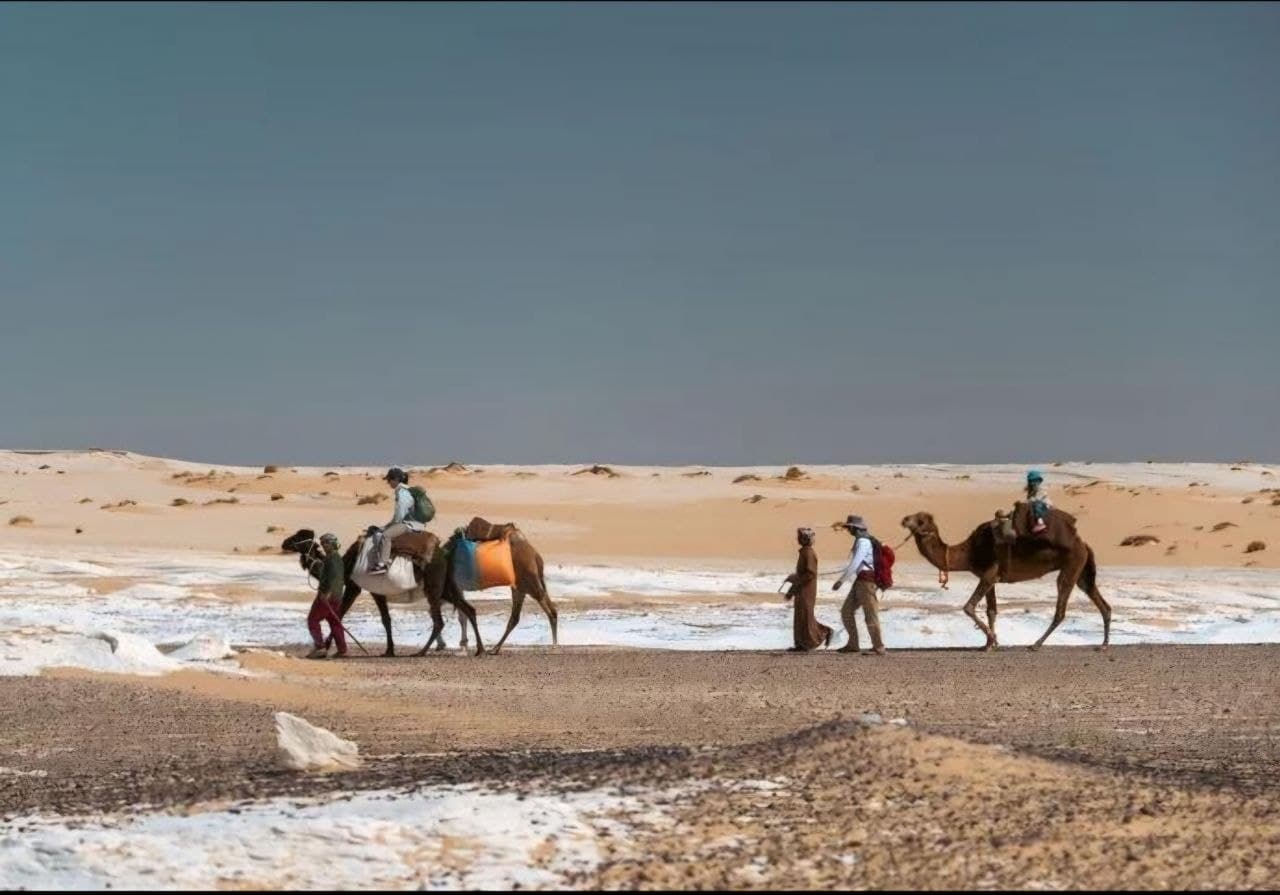
On Foot and By Camel: The Complete Guide to White Desert Trekking in Egypt
There's a fundamental difference between seeing the White Desert through the window of a speeding 4x4 and actually feeling it underfoot. The faint crunch of sand with every step, the sun's warmth on your shoulders, the rhythm of your breath syncing with a camel's unhurried gait — these are details no engine can ever translate for you. Trekking and camel riding in Egypt's Western Desert aren't simply a "slower" alternative to a car safari; they're a fundamentally different experience, one that resets your relationship with time, distance, and place. In this guide, we take you into the heart of this rare style of desert travel in Egypt, and explain everything you need to know before you pack your bag and set out.
Why Travelers Choose Trekking Over a Car Safari
Many assume a car safari is the only "correct" way to explore the Western Desert, but that overlooks the fact that the Bedouin themselves moved through this land for thousands of years on foot and camelback, long before any vehicle ever reached it. When you move at the same pace their ancestors did, details open up that are simply impossible to notice from a moving window: a rare desert plant tucked between rocks, a nocturnal animal's tracks in soft sand, or a subtle shift in a chalk formation's color as the sun's angle changes. White Desert trekking also gives you a genuine sense of personal accomplishment; every kilometer covered by your own effort leaves a different imprint on memory than one covered by a vehicle on your behalf. For travelers seeking real physical engagement alongside adventure, hours of walking among dunes and rock formations offer a rewarding challenge no conventional tour can match.
Camel Riding: Returning to the Desert's Original Mode of Travel
A camel is not merely a "traditional means of transport" trotted out for photo ops; it's a genuine travel companion, shaped over thousands of years to endure the harshest desert conditions imaginable. When you join a camel trekking trip in the Western Desert, our Bedouin guides first teach you how to interact with the animal, how to mount and dismount safely, and how to read its simple body language. The slow, swaying rhythm of camel riding creates an almost automatic meditative state; after half an hour of steady motion, your mind starts to unwind in a way that resembles active meditation. The extra height a camel's back gives you also opens up a panoramic view of the surrounding terrain, making for a completely different kind of photography. Longer, multi-day camel treks also revive the experience of the ancient trade caravans that once linked Egypt's oases along this very same route.
What to Expect on a Multi-Day Trek
Long treks through the White Desert are built around a clear daily rhythm: mornings begin early, when temperatures are mild and the light is soft and ideal for walking and photography; the caravan pauses at midday to rest and eat something light in the shade of the nearest rock formation, then resumes in the afternoon as the golden hour approaches. Camp is pitched in a different spot each evening, meaning you wake up every morning to an entirely new view. First-timers to the Western Desert can start with a relatively short five-day trek combining walking, camel riding, and camping — a balanced experience between physical adventure and comfort. Those looking for a longer, deeper challenge can take on an eight-day hiking program covering greater distances and more varied terrain, suited to travelers with a higher fitness level and a desire for full immersion, far from any trace of modern life.
Physical and Mental Preparation: Is Desert Trekking Right for You?
Contrary to popular belief, White Desert trekking doesn't require exceptional fitness or mountaineering experience. Walking is mostly over relatively flat sandy ground or gently rolling terrain, and the pace is set according to the group's ability, especially on private tours. More important than raw fitness is mental preparation: the ability to enjoy simplicity, accept total disconnection from the internet and daily noise, and stay open to a rhythm slower than you're used to. We recommend that first-time trekkers walk moderate distances in the weeks leading up to the trip to build some stamina, and wear broken-in, comfortable boots rather than brand-new ones — new footwear can cause painful friction on sand.
The Best Seasons for Trekking and Camel Riding
Choosing the ideal timing depends heavily on each traveler's heat tolerance. Autumn, from October to November, offers a perfect balance of warm, comfortable days for long walks and mildly cool nights ideal for camping. Winter, from December to February, suits those who don't handle heat well during physical exertion, though it demands warmer gear for the bitterly cold nights. Summer is the least suitable season for long daytime treks, and schedules are adjusted accordingly, starting at dawn and pausing before peak heat.
Your Trekking Pack: What Goes on Your Back, What the Camel Carries
One of the best things about organized trekking trips in the White Desert is that you're not required to carry everything yourself; camels carry the tents, heavy gear, and provisions, while your personal daypack is limited to what you actually need during walking hours. A refillable water bottle, a light extra layer for sudden weather shifts, a wide-brimmed hat or the traditional Bedouin keffiyeh, and polarized sunglasses to protect your eyes from the White Desert's fierce glare — these are the essentials for every walking day. Footwear is by far the most important item: choose broken-in, mid-height walking shoes rather than new ones, paired with thick socks that absorb friction, your first line of defense against blisters. Many seasoned trekkers also recommend at least one walking pole, which noticeably eases pressure on the knees when crossing gently raised dunes.
A Moment From the Trail: When Everything Falls Silent but Your Footsteps
One of our longtime guests described a moment on day three of a five-day trek: "I stopped suddenly in the middle of the trail — not because I was tired, but because I realized I couldn't hear anything at all except the sand under my boots and my own breathing. No engine, no phone notifications, nothing. I just stood there for a full minute, listening to that rare silence." These moments, impossible to plan or fully describe beforehand, are what make trekking fundamentally different from any other form of desert tourism; it isn't handed to you ready-made — it's discovered through patience and slow footsteps.
How to Start Your Journey
If you're ready to experience the White Desert this authentic, unhurried way, we have two trips designed exactly for this kind of adventure. You can set out on the 5-day camel trekking and camping expedition, the ideal experience for combining walking, camel riding, and camping into one balanced adventure. Or, if you're after a longer challenge and a deeper immersion far from any trace of modern life, the 8-day hiking program takes you deeper into the heart of the Western Desert. Both are led by local Bedouin guides who know every detail of this land, from seasonal water sources to the best wind-sheltered camping spots.
Trekking and camel riding in the White Desert aren't just an extra activity to tack onto your itinerary; they're an invitation to rediscover the desert the way its original people have known it for thousands of years. At Bedouin Trails, we believe the deepest experiences are the ones that demand your full presence, one step at a time, with nothing standing between you and the land. Book your trip today, and let the White Desert reveal its secrets to you at its own unhurried pace.
FAQ
Do I need prior trekking experience?
No — the routes are designed for average travelers, and your Bedouin guide sets the pace according to the group's level.
How far do we walk each day?
Daily distances typically range between 8 and 15 kilometers, split across the morning and afternoon, with regular rest stops.
Is camel riding uncomfortable or painful?
With the traditional padded saddles we use, and regular breaks to stretch your legs, most travelers find it comfortable even on longer trips.