
The White Desert in One Day: A Real Itinerary for People Who Can't Spare a Weekend
Most White Desert itineraries assume you have two or three days to give it. A night under the stars, a slow morning watching the chalk formations change color at sunrise, no rush anywhere. That's the right way to see it, and if you can swing it, you should. But a lot of travelers genuinely can't — a work trip to Cairo with one free Saturday, a stopover between flights, a visitor who wants to see Egypt's desert without giving up half their vacation to it. For that traveler, the question isn't whether to skip the White Desert — it's whether this can actually be done in a single day, and whether it's worth it if it can.
The honest answer is yes, with one condition: you have to leave early. Not early in the loose, hopeful sense people use when planning trips. Really early — moving before sunrise, not after it.
Why Starting Early Changes Everything
Many day trips like this start with people leaving Cairo a little later than they should, once the morning is already underway. That sounds reasonable on paper. In practice, it compresses everything that follows: you lose real daylight at the far end of the day, which in the White Desert isn't a minor inconvenience — it's the difference between leaving while there's still usable light for the last stretch of formations, or rushing the whole visit because the sun is already dropping.
Push the departure earlier instead — well before sunrise — and the entire day stretches out. You're on the road before the city traffic builds, which alone can save you a good chunk of time on the drive out. By the time you reach Bahariya Oasis — the gateway town where the paved road ends and the desert track begins — the heat hasn't become a factor yet, and the light is doing interesting things across the chalk formations rather than flattening them into midday glare.
What the Day Actually Looks Like
The day opens with the drive out of Cairo while the city is still quiet, coffee in the car rather than at a café beforehand — this early start isn't optional if you want the rest of the day to work. The first proper stop is Bahariya Oasis, where the trip pauses briefly for logistics: switching to 4x4 vehicles if you haven't already, a quick break, maybe a look at the basalt outcrops that mark the edge of the oasis before the open desert takes over.
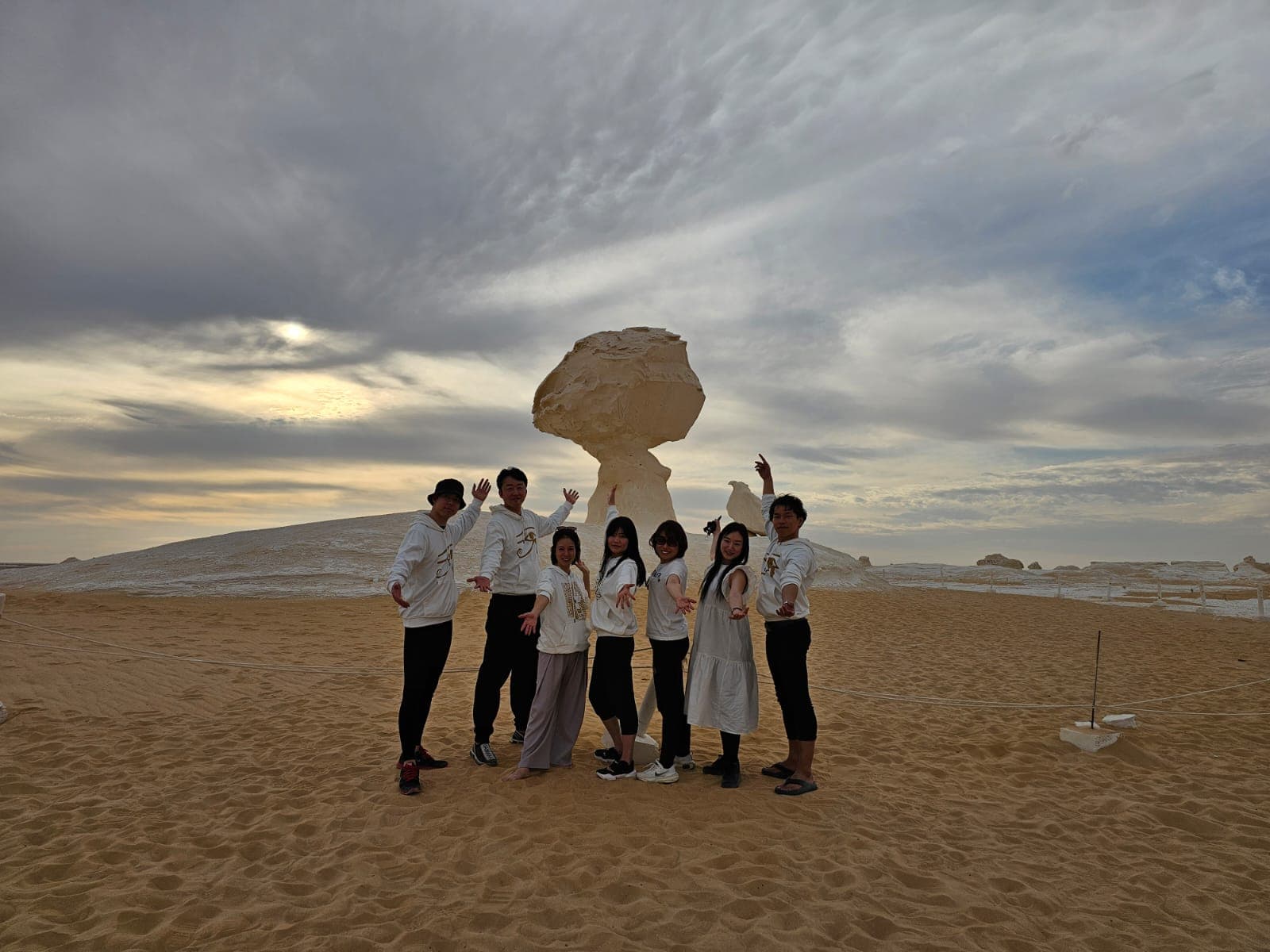
From there, the real window opens — several unhurried hours inside Sahara el-Beyda, enough time to see the formations that actually matter rather than racing past them. The classic stops — the Mushroom, the Chicken and the famous Sphinx-like rock, the open valley of pinnacles locals call Inselberg — all fit comfortably into this stretch if your guide paces it well. It's also, notably, enough time to actually get out and walk among the formations rather than just photographing them through a car window, which is the difference between seeing the White Desert and visiting it.
Lunch happens inside this same window — usually a simple desert meal set up in the shade of one of the larger formations, which sounds like a minor detail until you're actually sitting there eating grilled chicken and rice with chalk-white towers rising around you instead of restaurant walls.
Once the formations have had their time, the return drive begins with plenty of the afternoon still ahead. This is where the early start pays off — you're heading back with daylight to spare rather than racing darkness, which matters both for comfort and for the practical reality of desert roads after dark. By the time you're back in Cairo, it's been a long day, no question. But a complete one.
Is a Single Day Actually Enough?
Honestly — it's enough to understand why people fall for the White Desert, not enough to exhaust it. You'll see the headline formations, get the photos, understand the scale of the place. What you won't get is the version photographers chase: sunrise light hitting the chalk pinnacles from a camp you slept at the night before, or the particular stillness of the desert after everyone else has driven back to Cairo. If that's specifically what you're after, no single-day plan replaces an overnight trip — and it's worth being honest with yourself about which traveler you are before committing to the long drive.
For a deeper sense of what you'd be trading off by compressing the trip into a day versus spreading it across two or three, our breakdown of how many days the White Desert actually needs lays out exactly what each additional day adds — useful reading even if you've already decided a single day is what your schedule allows.
The Transport Question
A day trip like this lives or dies on the vehicle and driver, more than almost any other variable. The road from Cairo to Bahariya is straightforward highway driving, but the stretch from Bahariya into the White Desert itself is unpaved desert track, and comfort — along with how much of your four-to-five-hour window actually gets spent enjoying formations rather than being jostled around in a vehicle — depends heavily on getting that part right.
Most travelers default to whatever vehicle shows up without asking questions, which is a mistake specifically for a single-day trip, where there's no slack in the schedule to recover from a breakdown or a driver who doesn't know the terrain well enough to move efficiently between stops. If you want to understand what actually separates a smooth desert transfer from an uncomfortable one, it's worth reading through our guide on getting from Cairo to the White Desert before booking anything — the right setup is what makes that early start actually worth it rather than just a rough, tiring day.
Who This Trip Is Actually For
This isn't the ideal way to see the White Desert — ask anyone who's camped there overnight and they'll tell you the stars and the sunrise are what make the place unforgettable rather than merely impressive. But ideal isn't always available, and a well-run single-day trip is a real, satisfying way to experience one of Egypt's most distinctive landscapes if a full weekend simply isn't on the table.
It works best for a specific kind of traveler: someone already in Cairo for other reasons with exactly one day to spare, someone deciding between the White Desert and nothing at all rather than between one day and three, or someone who wants a preview before committing to a longer desert trip on a future visit. For all of those travelers, a very early start is a small price for an afternoon spent walking among chalk towers that look like nothing else on the planet — and being back in your own bed in Cairo by the time most overnight desert trips are still unpacking their camp for the night.
If your schedule allows even one extra day, it's worth seriously considering stretching the trip — but if it genuinely doesn't, this is the version that makes the White Desert work anyway, and it's a far better use of a single free day than most alternatives Cairo has to offer.
FAQ
Can you visit the White Desert as a day trip from Cairo?
Yes, but only if you leave well before sunrise — ideally around 4–5am. The drive is roughly four hours each way. Leaving early gives you four to five unrushed hours in the desert itself before a comfortable return drive. Leaving after sunrise compresses the time severely and you'll spend the return leg racing darkness.
What is the White Desert and why do people visit it?
The White Desert (Sahara el-Beyda) is a national park in Egypt's Western Desert, roughly 500km southwest of Cairo. It's famous for its surreal white chalk formations — wind-eroded pinnacles, mushroom shapes, and abstract sculptures that look unlike any desert landscape on Earth. Most visitors come for overnight camping under the stars, but a day trip is also possible with an early start.
What should I pack for a one-day White Desert trip from Cairo?
Layers are essential — early mornings in the desert are surprisingly cool, afternoons get hot. Wear walking shoes suitable for sand and soft rock. Bring at least 2–3 litres of water per person, sunglasses, a hat (the reflected glare off white chalk is intense), and a portable phone charger. A camera with extra storage is worth it — the formations photograph well from every angle.