White Desert Camping: A Night Under the Stars in Egypt (2026)
Most visitors to the White Desert come for the rocks. They leave talking about the night.
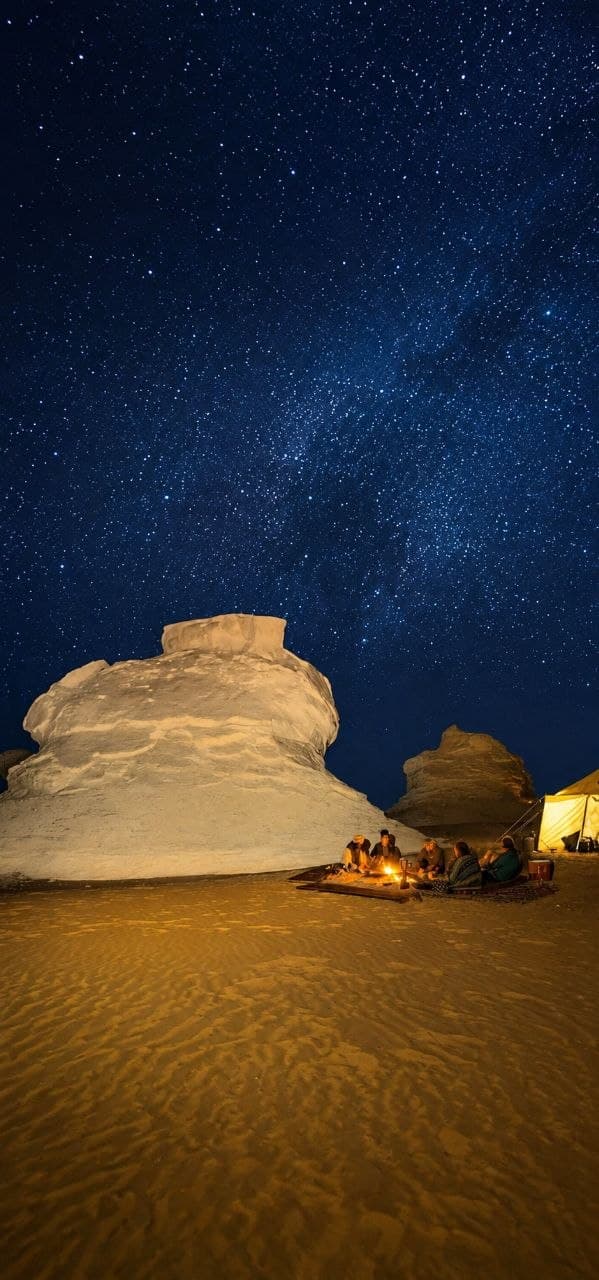
There is something about sleeping out in the open desert beneath formations carved by 80 million years of wind, under a sky so dense with stars that it casts faint shadows on the chalk, that no description fully prepares you for. People who have stayed in luxury hotels across the globe often describe a night in the White Desert as the best sleep of their lives. Photographers marvel at a Milky Way that looks computer-generated. Quiet travelers and introverts describe a silence so complete they can hear their own pulse.
If you are considering a White Desert safari, this guide explains exactly what camping in the White Desert is—and what it is not—so you arrive knowing precisely what to expect.
What White Desert Camping Is Really Like
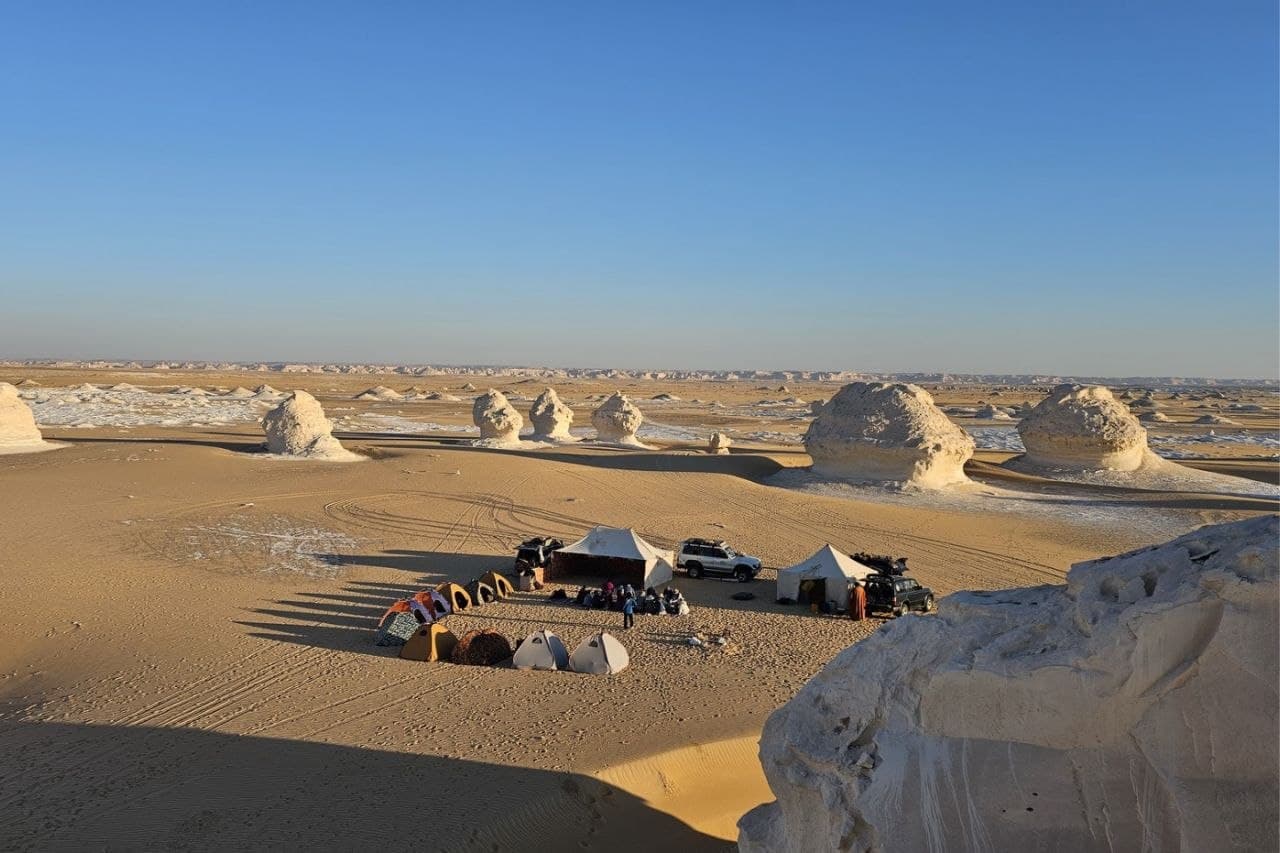
White Desert camping is open-air camping: you sleep under the stars, not inside a tent. There are no permanent structures, no glamping domes, and no fixed campsites with plumbed bathrooms. Every evening, your Bedouin guide chooses a sheltered spot among the chalk monoliths, sets up a perimeter with vehicles and gear, builds a central fire, and lays out thick sleeping mats and warm blankets in a semi-circle facing the night sky.
This is entirely deliberate. The entire magic of the White Desert is its night sky; any roof, even the canopy of a tent, cuts off the view. Most regular operators in the region, including Bedouin Trails, utilize windbreaks and heavy bedding rather than enclosed tents.
The setup typically includes:
- Sleeping mats: Thick foam mattresses that insulate against the cool desert sand.
- Sleeping bags: Rated for the season (winter bags rated down to 0°C).
- Wool blankets: Extra heavy layers for crisp desert nights.
- Central campfire: Used for traditional cooking and warmth.
- Camp kitchen area: Where your crew freshly prepares meals.
- Vehicle windbreaks: Arranged to block desert breezes when needed.
It is not roughing it, but it is not glamping either. It is an authentic, traditional Bedouin camp, and most travelers find it far more memorable for that exact reason.
Bedouin Trails Tip: If you feel nervous about sleeping in the open air, we can readily set up a small dome tent upon request. About 1 in 20 of our guests asks for this. However, before you decide, we encourage you to try one night under the open sky; almost everyone who does ends up wishing they had more nights like it.
The Night Sky: What to Expect
The White Desert has zero light pollution. The nearest small town (Bahariya) is two hours away, and the nearest major city is hundreds of kilometers across the sands. What this means for the night sky is difficult to convey to anyone who has only seen stars from urban areas.
From October through April, on a moonless night, the Milky Way rises from one horizon and arches cleanly across the entire dome of the sky. It is not a faint, blurry smudge; it is a dense, glowing river of light. Constellations are pin-sharp, and individual stars have visible colors: some unmistakably red (Antares, Betelgeuse) and others piercingly blue (Sirius, Vega).
Shooting stars are constant; most travelers spot 3 to 5 within an hour, with significantly higher counts during annual meteor showers (Perseids in August, Geminids in December). The International Space Station is clearly visible as it glides overhead.
If you have never experienced a true dark sky, the view can be deeply moving. It is completely normal for travelers to be brought to tears on their first night—we have witnessed it dozens of times.
What You Eat at a White Desert Camp
Bedouin desert cooking is consistently one of the biggest surprises of the trip. Most travelers anticipate basic campfire rations and are astonished by the culinary skill displayed over open embers.
Typical Dinner
Dinner is built around a hearty main protein (grilled chicken, tender lamb, or rich vegetable tagines for vegetarians), accompanied by rice or couscous, fresh chopped salads, spiced lentil soup, and freshly baked Bedouin flatbread (baked directly in a lidded pan buried in hot embers—truly exceptional). Bedouin herbal tea is brewed and served continuously throughout the evening.
Typical Breakfast
Breakfast is fresh, colorful, and generous: eggs prepared to order, warm foul mudammas (fava beans with cumin and olive oil), white cheeses, olives, fresh tomatoes and cucumbers, flatbread, fruit jams, halawa (sesame sweet), and tea or coffee. Many guests note it is among the best breakfasts of their Egypt journey.
Dietary Requirements
Vegetarian, vegan, halal, gluten-free, and most allergy-related diets are seamlessly accommodated with advance notice. Simply let us know upon booking.
Bathroom Logistics: The Honest Answer
There are no built toilet facilities within the White Desert National Park. This is the single most common question we receive, so let us address it with complete transparency.
At Bedouin Trails camps, we set up a dedicated private toilet area sheltered behind a tall windbreak, placed discreetly away from the central camp. We provide a portable camp toilet system (chemical or deep-trench style depending on the expedition) so you never have to dig your own hole. Toilet paper and hand sanitizer are always stocked. We practice strict Leave No Trace ethics—everything brought into the desert is packed out.
For washing, we supply basins of warm water for hands and face. There are no showers; on a 2-to-3-day desert safari, you will find the dry desert air keeps you surprisingly clean. For longer itineraries, full hot showers are arranged at oasis transit lodges.
It is basic, comfortable, and manageable for virtually every traveler—and the night sky makes it well worth it.
Temperatures: How Cold Does It Get?
Nighttime temperatures in the White Desert fluctuate significantly across the seasons:
- November to February: 3°C to 9°C at night, occasionally dipping near freezing just before dawn. Crisp and chilly, but easily managed with quality bedding.
- October & March: 8°C to 14°C at night. Fresh, invigorating, and very pleasant.
- April & September: 12°C to 18°C at night. Mild and gentle.
- May & late September: 15°C to 22°C. Warm evenings.
- June to August: 22°C to 28°C at night. Too warm for optimal comfort; we advise against desert camping during mid-summer.
Bedouin Trails provides heavy-duty, season-appropriate sleeping bags and blankets on every departure, so you do not need to pack your own.
Safety and Wildlife
The White Desert is among the safest wilderness camping destinations on earth. There are no dangerous large predators, no venomous snakes active during the winter camping season (when 95% of trips operate), and scorpions are not encountered around typical chalk campsites.
What you might see at night: tiny desert fennec foxes (the charismatic icon of the Sahara), occasional jerboas (desert hopping mice), and harmless bats darting above the campfire light. Inquisitive desert foxes sometimes skirt the outer camp quietly at night—they are completely harmless and a delight to watch.
Biting insects are virtually absent due to the arid landscape and lack of standing water; mosquitoes are non-existent.
How Many Nights Should You Camp?
Most travelers spend 1 to 3 nights camping in the White Desert. Here is how to choose the right length:
- 1 Night: Ideal for first-timers with limited schedules. Combined with the Black Desert and Crystal Mountain, it delivers a comprehensive overview. (See our 2-Day Safari).
- 2 Nights: Far superior to one. The first night acclimates you to the wilderness; the second night is when you truly unwind and disconnect. Highly recommended. (See our 3-Day Safari).
- 3 Nights: Best for dedicated slow travelers, astrophotographers, and wellness or meditation retreats. Our 4-day deep desert journeys are tailored for this depth.
If your itinerary permits, choose two nights over one—the depth of the experience expands exponentially.
FAQ
Is White Desert camping comfortable?
Surprisingly so. The majority of travelers report sleeping deeper and better than they have in months. The crisp, clean air, total absence of noise, and thick mattress padding with heavy blankets create ideal rest conditions.
Are there scorpions or snakes in the White Desert?
They are practically never encountered during the regular winter camping season (October through April). Desert reptiles are nocturnal and hibernate during cooler months, while scorpions avoid open chalk plains. We have never had a safety incident on any tour.
What happens if it rains?
Rainfall in the White Desert is extraordinary rare—less than 5 mm per year. In the unlikely event of precipitation, weatherproof expedition tents can be erected in minutes. Over 15 years of operating in the Sahara, weather-induced camp relocations have happened only twice.
Is the campsite private, or do we share with other groups?
All Bedouin Trails camps are 100% private to your booking. We never merge unrelated groups or herd guests into communal tourist camps. This privacy is the core reason our desert journeys feel so profound and personal.