Crystal Mountain in Egypt: The Quartz Jewel Between Two Deserts
Roughly midway between the Black Desert and the White Desert in Egypt, on a quiet stretch of road that no independent tourist would otherwise notice, sits one of the country's strangest geological marvels: a small hill of pure crystal, glinting in the sun like something out of a fantasy novel.
This is Crystal Mountain, a single rock outcrop composed almost entirely of crystallized quartz and calcite, exposed on the surface and flashing in every direction. Stand on it on a sunny midday and the entire ridge glitters. Sit beside it at sunset and the rocks turn pale pink and amber. It is the kind of place that stops first-time visitors in their tracks.
If you are driving from Cairo down to the White Desert, Crystal Mountain is one of the most rewarding 30-minute diversions you will make on the entire journey. Here is everything you need to know.
What Is Crystal Mountain?
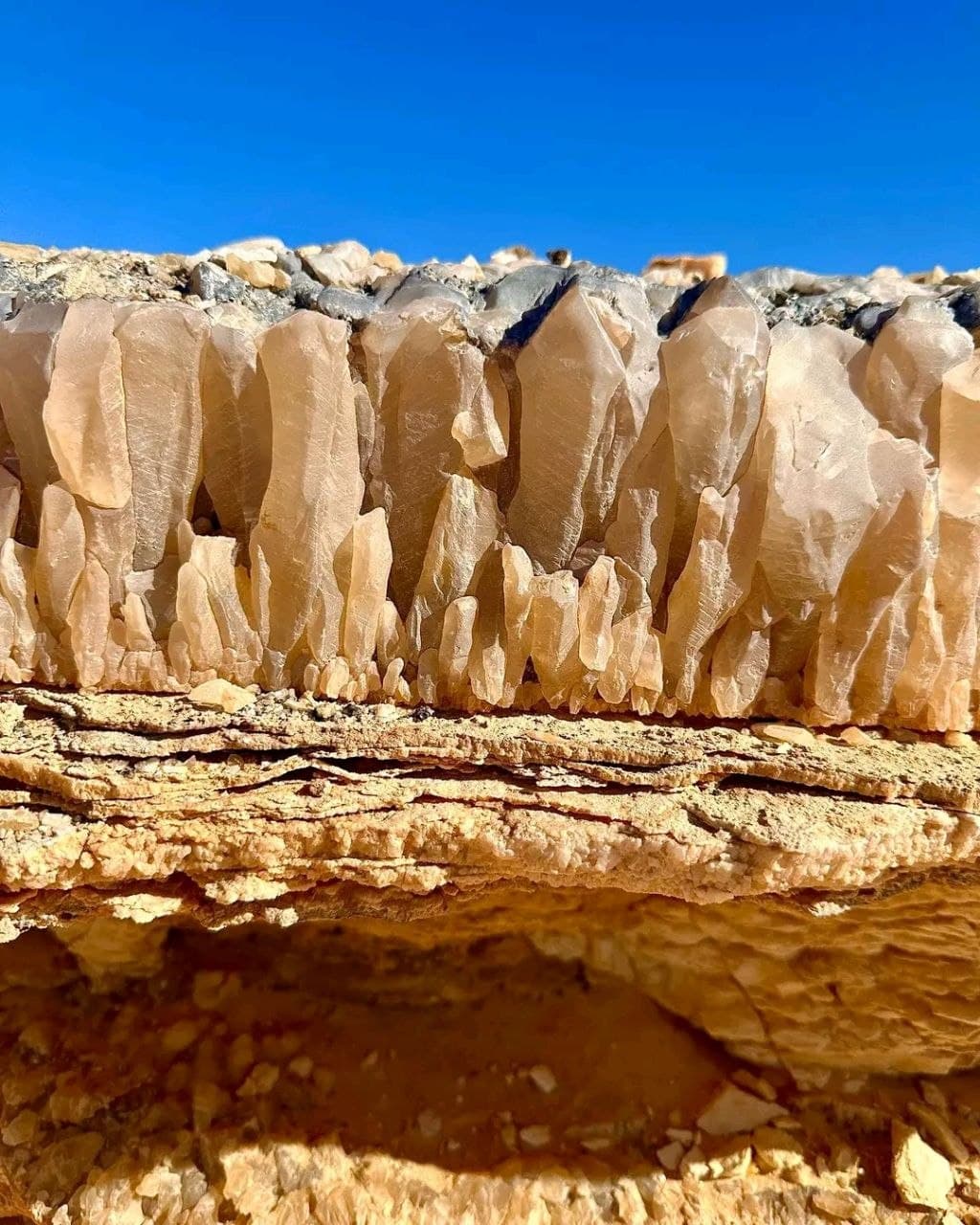
Crystal Mountain is a small rock outcrop located along the road between Bahariya Oasis and Farafra, roughly 100 km south of Bahariya and 60 km north of Farafra. Technically it is not a "mountain" — it is more accurately described as a ridge or small knoll, perhaps 10 meters high at its crest. But its surface is composed almost entirely of shimmering crystalline minerals, primarily quartz and calcite with traces of barite.
What makes it geologically fascinating is the formation itself: the crystals are exposed because the surrounding sedimentary rock eroded away over millions of years, leaving the harder mineralized core standing proud above ground level. There is even a small natural "window" or arch on one side — a hole right through the rock created by the same erosion process, which is the signature feature most photographers look for.
Understanding this matters because it explains why the surface is so densely crystalline: you are literally walking on what was once an underground vein of mineral deposits, now exposed by deep time.
Bedouin Trails Tip: Crystal Mountain is unfortunately vulnerable to over-collecting. For decades, visitors broke off pieces as souvenirs, and you can see the damage. Today, removing crystals is strictly prohibited, and our guides actively discourage it. If you want a souvenir, take a photograph. The mountain is far more beautiful intact than on a shelf.
Why Crystal Mountain Matters Geologically
Crystal Mountain is not unique globally — quartz and calcite veins exist in many parts of the world. What makes it special is accessibility: it sits right at the surface, right along a paved road, in the middle of one of Egypt's most popular desert tourism routes.
The crystals themselves formed underground, deep within the surrounding limestone, when mineral-rich hydrothermal fluids seeped into fractures and slowly deposited quartz and calcite over millions of years. The process is similar to how geodes form elsewhere in the world. Above ground, what you see is the result of erosion bringing this hidden mineral wealth into daylight.
Some specimens from Crystal Mountain have been studied as museum-grade mineral samples. The quartz is mostly clear to milky white, sometimes appearing in pink or yellowish hues where iron has stained it. The calcite forms larger, blockier crystals that catch the most light and give the surface its characteristic sparkle.
How to Visit Crystal Mountain
Crystal Mountain is one of the easiest desert sites in Egypt to visit because it sits directly off the paved Bahariya–Farafra road. There are no entrance fees, no formal gates, and no permits required.
Driving Directions
From Bahariya, drive south on the main highway toward Farafra. At roughly 100 km (just over an hour), look for a small pull-off on the left (east) side of the road. Crystal Mountain is right there — you cannot miss it once you know what to look for. The famous arch is located near the crest of the small ridge.
If you have driven more than 1.5 hours from Bahariya without seeing it, you have gone too far.
As Part of a Desert Safari
If you are on a Bedouin Trails desert safari, you don't need to worry about logistics; Crystal Mountain is included as a natural stop on every itinerary traveling between Bahariya and the White Desert. Most guides schedule it as a 20–30 minute break: you arrive, walk around the formations, photograph the arch, and move on.
Specifically, our 3-Day White Desert & Black Desert Safari includes Crystal Mountain as part of the standard route connecting the two deserts.
What to See and Do
Crystal Mountain is compact; most visitors find 20–40 minutes plenty. Within that time, the main highlights are:
- The Crystal Arch: The signature feature. A natural window through the rock, roughly 1.5 meters across, framed by gleaming crystalline walls. Almost every photo of Crystal Mountain features this arch, and with good reason: walking through it, sitting beside it, and framing the distant desert through it is deeply satisfying.
- The Crystalline Surface: Walk around the base of the outcrop to see the rock face up close. In direct sunlight, it literally sparkles: thousands of small crystal faces catch light from every angle. Get close. Look at the textures. The variety in crystal size and coloration is remarkable.
- The Surrounding Desert Panorama: Crystal Mountain sits in a vast, flat desert plain. From the small ridge, you have unobstructed views to the horizon in every direction. It is a worthwhile stop just to stretch, breathe, and take in the desert landscape before continuing south into the White Desert or north back toward Bahariya.
Crystal Mountain Photography Tips
- Best Light in Late Morning or Late Afternoon: Crystals catch low-angle light dramatically. Avoid midday if possible, as harsh overhead sun creates excessive contrast.
- Use a Polarizing Filter: This reduces glare on crystal faces and brings out subtle color variations.
- Get Close: Macro shots or close-focus compositions of the crystal surfaces make stunning abstract photographs.
- Frame Through the Arch: Position yourself to shoot through the natural window with the open desert beyond — the quintessential Crystal Mountain shot.
- Include Scale: A person standing near the arch gives the image instant reference and dramatic scale.
Combining Crystal Mountain with Other Stops
Crystal Mountain is rarely a standalone destination; it is a stop along a longer journey. Natural combinations include:
- Black Desert + Crystal Mountain + White Desert: The classic Western Desert circuit. See our 3-day safari.
- Bahariya Oasis + Crystal Mountain + White Desert: A shorter 2-day version ideal for a weekend getaway from Cairo.
- Crystal Mountain + Djara Cave: For travelers seeking a more adventurous route, our 3-Day White Desert & Djara Cave tour covers both.
Whichever route you choose, budget 20–40 minutes for Crystal Mountain. Less feels rushed; more is difficult to fill given the site's compact size.
Best Time to Visit
The ideal visiting window matches the broader Western Desert season: October through April. Crystal Mountain photographs best in lower-angle light, making mornings or late afternoons far better than midday. Avoid June through August unless you are making only a brief stop: the dark crystals absorb intense heat, and the surrounding plain offers no shade.
Within that peak window, late October through February is ideal: crisp clear skies, dramatic light without strong winds, and comfortable temperatures for exploring the rock formations without sun protection becoming critical.
FAQ
Can I take a crystal as a souvenir?
No. Removing crystals from Crystal Mountain is strictly prohibited, and the site has already suffered visible damage from past collection. Bedouin Trails guides actively discourage taking anything. Photos are encouraged; physical souvenirs are not.
Is visiting Crystal Mountain free?
Yes. There are no entrance fees, ticket booths, or permits required. You can pull over briefly at any time while driving the Bahariya–Farafra road.
How much time should I spend at Crystal Mountain?
Most visitors find 20–40 minutes sufficient. It is a compact site — plenty of time to explore, photograph the arch and crystal surfaces, and continue onward. Photographers may prefer a bit longer in golden hour light.
Is it safe to climb on Crystal Mountain?
Climbing onto the formation is discouraged for safety reasons and to protect the fragile crystals from further damage. The base and the area surrounding the arch are fully accessible without climbing.
Is Crystal Mountain visible from the road?
Yes, but it is easy to miss if you aren't looking out for it. There is an informal roadside pull-off. On a guided safari, your driver will know the exact stopping point.