Kharga Oasis in Egypt: History, Temples & Darb El-Arbain
Of all the Western Desert oases in Egypt, Kharga is the least visited and arguably the most historically consequential. For over 2,000 years, it was the pivotal stop on the Darb El-Arbain, the legendary caravan route that ferried gold, enslaved people, ostrich feathers, and ivory from Sudan north into Egypt. Persian fortresses, Roman temples, early Coptic Christian necropolises, and ancient underground aqueducts all endure here, set against a desert landscape that almost no standard tourists ever witness.
Kharga is tailored for the serious history-minded traveler. It is not primarily a destination for scenic dune lounging or picture-postcard resort photos; rather, it is where you go to walk among 2,500-year-old temples that receive almost no crowds, to trace the exact historic corridor through which sub-Saharan Africa's riches journeyed north for centuries, and to comprehend a vital dimension of Egypt that sits far beyond standard dynastic narratives.
Where is Kharga Oasis Located?
Kharga is the southernmost of Egypt's major Western Desert oases, situated roughly 580 km south of Cairo and 250 km west of Luxor. It forms a long, slender depression running primarily north-to-south, with its administrative hub—also named Kharga—at its center. The oasis serves as the capital of the New Valley Governorate, granting it civic importance even though it maintains a quieter, more subdued atmosphere than its northern sister oases.
Crucially, Kharga stands at the northern terminus of the Darb El-Arbain, the grand caravan highway originating in Darfur (Sudan) and terminating in Egypt's Nile Valley, an active trade lifeline operating continuously from the Pharaonic era through the early 20th century.
Bedouin Trails Tip: Kharga is most rewarding when undertaken as part of an overland desert crossing connecting Cairo and Luxor. Traveling via Dakhla and Kharga avoids backtracking and gives you the complete historical survey of the Darb El-Arbain. As a standalone out-and-back journey from Cairo, it involves too long a drive for just one oasis, but as part of an extended itinerary, it is essential.
Top Highlights to See in Kharga
- 1. Hibis Temple: The most significant Persian-era temple in Egypt and Kharga's crowning architectural jewel. Begun around 522 BCE under Darius I and expanded over subsequent centuries, the temple is dedicated to the Theban Triad (Amun, Mut, and Khonsu). It is the only intact Persian-period temple standing in Egypt—a survival of exceptional archaeological importance. It features exquisitely preserved wall reliefs, painted ceilings, and extensive liturgical inscriptions. Allow 60–90 minutes.
- 2. Bagawat Necropolis: One of the earliest and best-preserved early Christian burial grounds in the world. Bagawat encompasses 263 mudbrick chapels constructed over Christian tombs from roughly the 3rd to the 7th century CE, when Kharga harbored a flourishing Coptic community. Several chapels preserve vivid biblical frescoes, notably the Chapel of the Exodus and the Chapel of Peace. It is an extraordinary, poignant, and rare historical site.
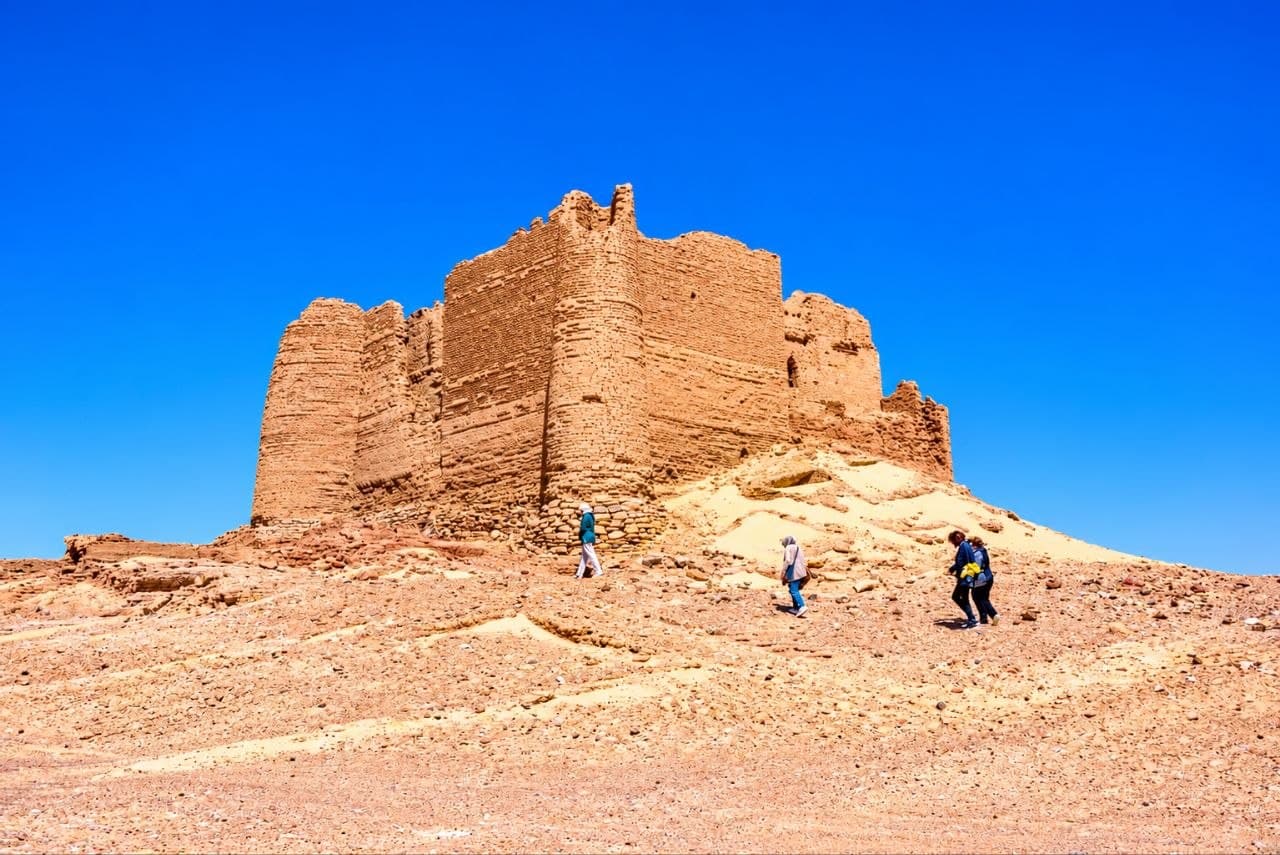
- 3. Qasr El-Ghuweita Fortress: A massive mudbrick fort and temple complex located approximately 20 km south of Kharga town. Dating back to the 25th Dynasty (c. 700 BCE) with significant Ptolemaic and Roman expansions, its towering outer walls still rise dramatically above the desert floor. Worth a dedicated 60-minute visit.
- 4. Qasr El-Zayyan: Another fortified temple complex situated just 5 km south of Ghuweita. While smaller in scale, its fortress walls and sanctuary remain impressive, and it is routinely paired with Ghuweita in a single half-day archaeological excursion.
- 5. Temple & Fortress of Dush: Located at the southern tip of the oasis lie the ruins of ancient Kysis, featuring a Roman stone temple dedicated to Isis and Serapis constructed under emperors Trajan and Domitian. While parts of the settlement are heavily weathered, its location on the historic frontier facing south toward Sudan imparts a powerful, remote atmosphere.
- 6. Kharga Archaeological Museum: A well-curated museum in Kharga town displaying artifacts discovered across the oasis's diverse eras: Pharaonic, Persian, Greco-Roman, and Coptic. It serves as an informative orientation stop before exploring the field sites.
The Historical Significance of Kharga: Darb El-Arbain
The Darb El-Arbain translates literally as the "Forty Days' Road." It was one of the longest, most arduous, and historically vital trade arteries in pre-modern Africa. Camel caravans transported goods from the Darfur region in modern-day Sudan northward across roughly 1,700 km of hyper-arid desert to Asyut on the Egyptian Nile, a journey typically requiring about 40 days.
Kharga served as an indispensable northern staging post. The oasis provided subterranean fresh water, agricultural provisions, rest, and garrisoned security for exhausted caravans that otherwise faced hundreds of kilometers of unbroken wilderness. At its zenith during the Ottoman period, tens of thousands of camels and traders traversed Kharga annually, bearing gold, ivory, ostrich feathers, gum arabic, and other valuable African commodities north.
By visiting Kharga and walking through its desert outposts, you stand directly on the physical infrastructure that powered one of Africa's greatest historical trading networks—a history unfamiliar to the vast majority of visitors to Egypt.
How to Get to Kharga
- From Cairo via the Western Desert: 8–9 hours direct drive, though realistically experienced as a 2-day overland route with an overnight stay in Dakhla or Farafra.
- From Luxor: 4 hours northwest via the Western Desert highway; this represents the most practical, quickest, and standard route used for Cairo–Luxor overland circuits.
- From Dakhla: 2.5–3 hours east along a well-paved desert highway.
- Flight Access: There is currently no regular scheduled commercial airline service operating to Kharga airport for most of the year.
Where to Stay in Kharga
Accommodation choices in Kharga remain modest and limited. The primary establishment is the Sol Y Mar Pioneers Hotel (formerly Pioneers Hotel), a clean and functional mid-range property located within Kharga town. A handful of small local guesthouses also operate seasonally. Most multi-day desert safari expeditions that include Kharga base themselves at the Sol Y Mar Pioneers for 1–2 nights.
Best Time to Visit Kharga
The optimal window to explore Kharga is between October and April, in line with the rest of Egypt's Western Desert. Summer is brutally hot, with Kharga consistently recording some of Egypt's highest temperatures during July and August. Winter and the shoulder months provide mild, comfortable daytime temperatures ideal for hiking through archaeological ruins and open-air desert forts.
FAQ
Is Kharga Oasis worth visiting?
For travelers focused on history, archaeology, and off-the-beaten-path expeditions, absolutely. Hibis Temple alone is among the most important Persian-era monuments preserved anywhere on Earth. For visitors seeking recreational desert landscapes or resort-style relaxation, Kharga offers less appeal than Siwa or Dakhla, making it best experienced as part of a broader overland itinerary.
How much time do I need in Kharga?
A stay of 1 to 2 nights is ideal to comfortably explore all primary archaeological sites including Hibis, Bagawat, Ghuweita, and Dush without rushing.
Is Kharga safe to visit?
Yes, Kharga Oasis is peaceful, welcoming, and secure. The paved approach roads from both Luxor and Dakhla are in good condition and regularly maintained.
Can I combine Kharga with Luxor?
Yes. Kharga is only about a 4-hour drive from Luxor, making it an easy addition to Upper Egypt itineraries. Many travelers complete a grand one-way circuit: Luxor – Kharga – Dakhla – Farafra – White Desert – Cairo.
Are the temples and sites open to visitors?
Yes, all primary sites—Hibis Temple, Bagawat Necropolis, Qasr El-Ghuweita, Qasr El-Zayyan, and Dush—are open with standard entry tickets. Hiring a qualified licensed guide is strongly recommended to fully appreciate the complex historical context of each monument.