Black Desert vs White Desert in Egypt: Differences & Which to Visit
The Egyptian Western Desert hosts two of the most dramatic landscapes on the African continent, separated by just a two-hour drive. The Black Desert, with its volcanic cones and dark gravel plains, is older, rugged, and far less photographed. The White Desert, with its surreal chalk rock formations and luminous Milky Way night skies, is the superstar that graces travel magazine covers and Instagram feeds worldwide.
If you only have time for one, which should you choose? And if you plan to visit both, what should you expect from each?
Below is an honest, side-by-side comparison written by a team of local Bedouin guides who lead expeditions across both landscapes every week of the desert season. We cover geological origins, look and feel, top activities, photography tips, logistics, crowds, and our definitive recommendations for different types of travelers.
Quick Answer: Which Desert Should You Visit?
- If you have only one day: Choose the White Desert. It is visually unmatched, the night skies are unbeatable, and an overnight desert camp delivers a once-in-a-lifetime experience.
- If you have two or more days: Visit both. They are perfectly complementary, only 1.5–2 hours apart, and most safari itineraries naturally include the Black Desert on the route to the White Desert.
- If you are a photographer or geology enthusiast: Lean into the Black Desert. Its volcanic cones, dark dolerite plains, and dramatic contrast against the sky yield unique compositions found nowhere else.
- If you are a first-time desert traveler with limited time: The White Desert is a more spectacular standalone destination. Don't overthink it.
Bedouin Trails Tip: The best choice for most travelers is to experience both on a single safari. The two landscapes are separated by just 1.5 to 2 hours in a 4x4, and the dramatic visual shift — from dark volcanic terrain into blinding white chalk towers — is one of the most unforgettable desert transitions on Earth.
Origin & Geology: How Different Are They?
The two deserts have entirely different geological origins, which explains why they look like two distinct planets:
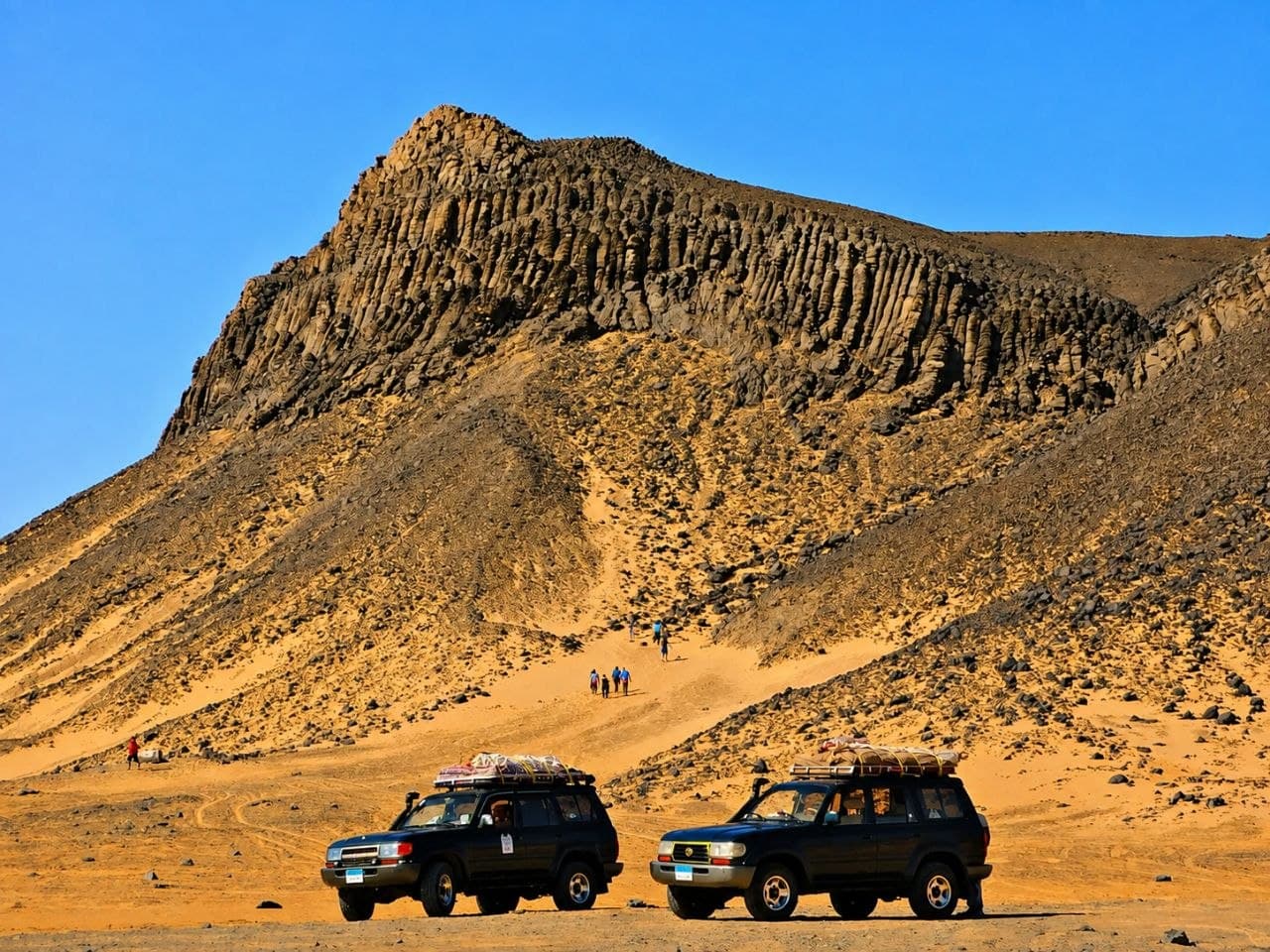
- The Black Desert: Formed by volcanic activity approximately 180 million years ago (Jurassic period). Magma pushed up through softer sedimentary layers and solidified into dark basalt and dolerite. Over millions of years, surrounding sandstone eroded away faster, leaving conical hills capped by hard volcanic rock. The black coating comes from weathered iron oxide (rust) and manganese patina.
- The White Desert: Formed by marine sedimentation 80–90 million years ago (Cretaceous period), when the region lay beneath a shallow prehistoric ocean. Countless marine micro-organisms deposited layers of calcium carbonate (chalk). When the sea receded, wind and blowing sand spent millennia carving the soft chalk into the whimsical sculptures seen today.
In short: the Black Desert is volcanic, while the White Desert is marine. They are separated by nearly 100 million years of geological history.
Look and Feel
The Black Desert
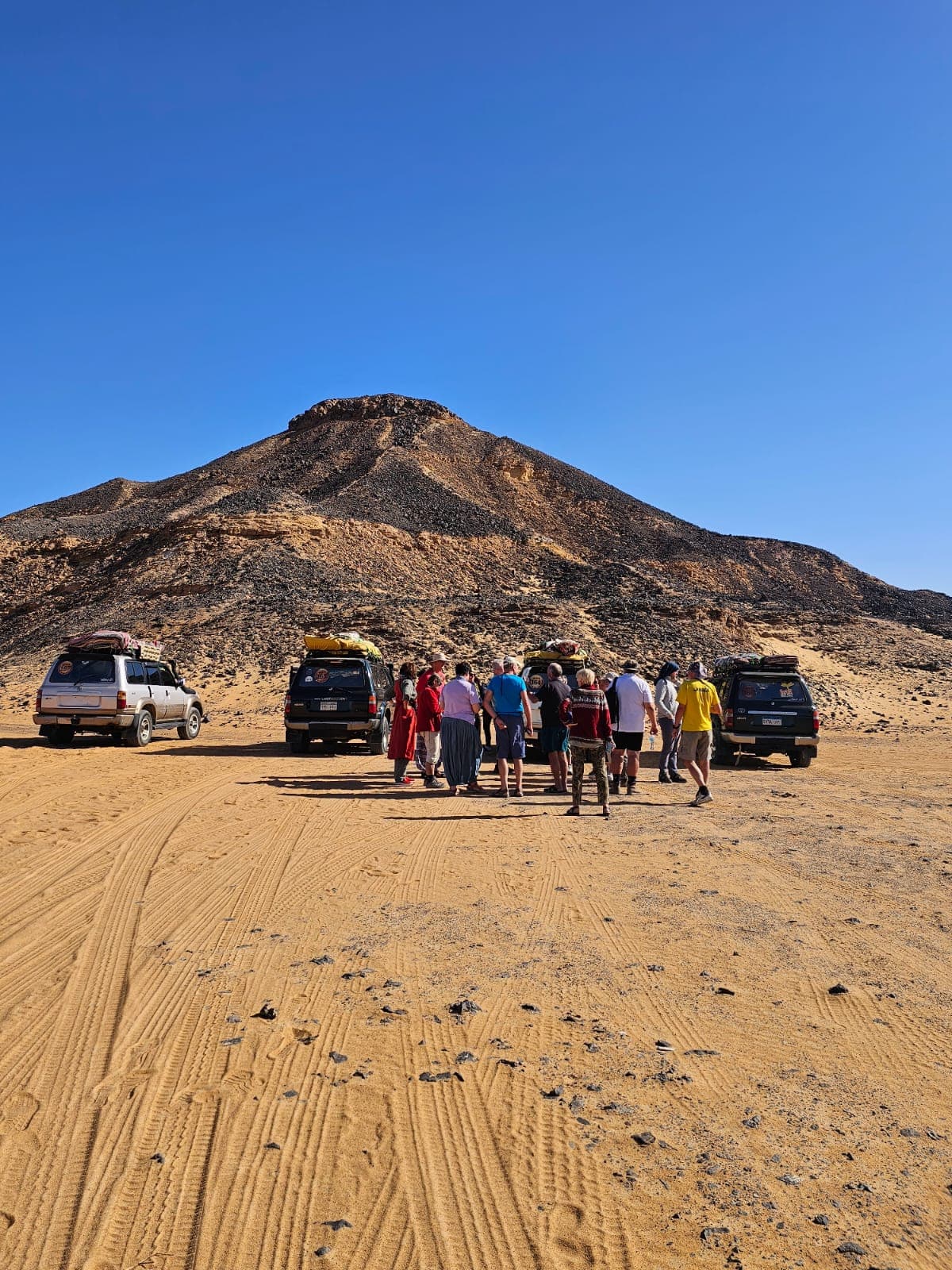
A vast expanse of grey and amber plains punctuated by hundreds of conical dark hills. The ground feels coarse underfoot, strewn with basalt shards, volcanic gravel, and weathered boulders. Colors range from deep chocolate brown to charcoal black, with reddish iron streaks exposed along erosion lines. In the golden hour, the landscape glows with a quiet, primeval majesty.
The White Desert
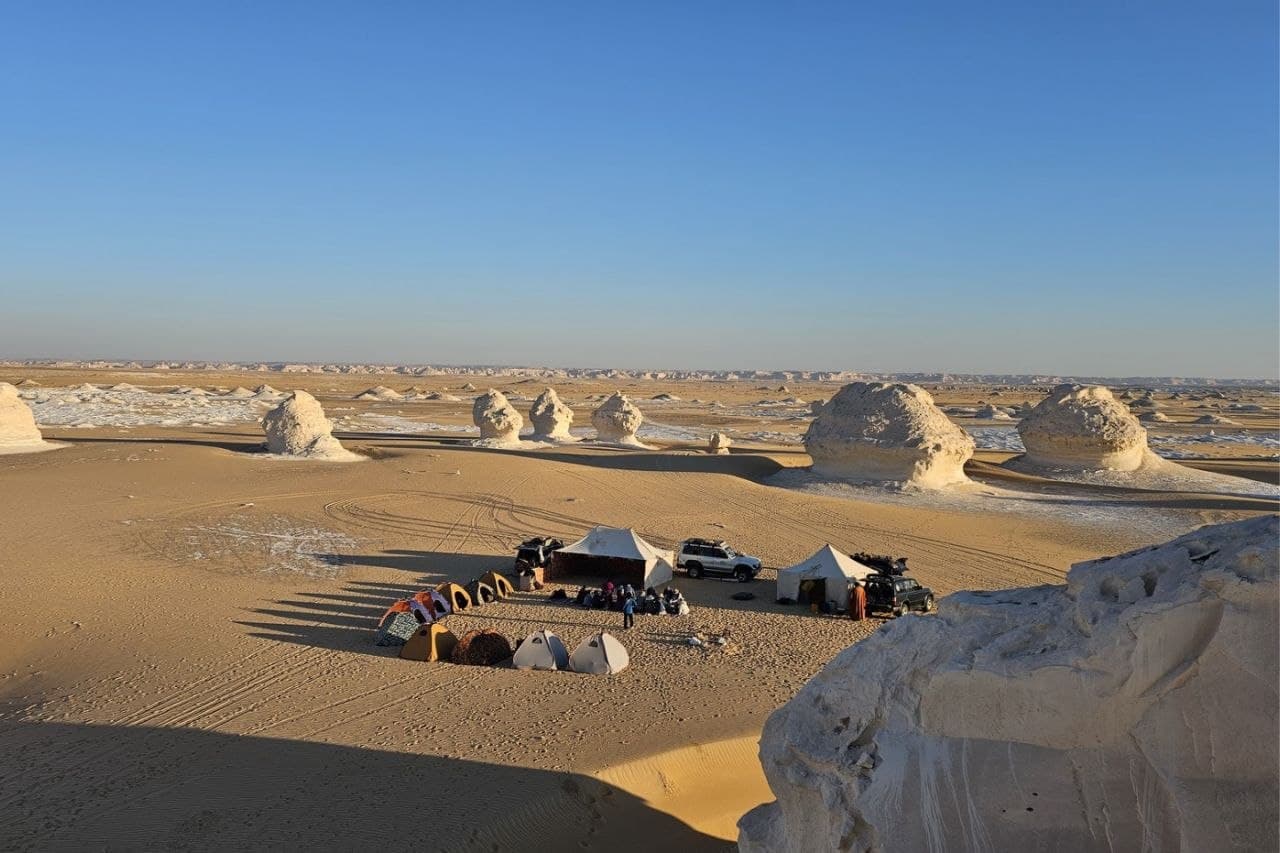
A dreamscape of blinding white chalk sculptures rising from soft golden sand dunes — shaped like mushrooms, chickens, sphinxes, and abstract monoliths. The chalk reflects light dynamically throughout the day: creamy off-white at dawn, dazzling bright at noon, and warm amber-pink at sunset. Underfoot is soft windblown sand. At night, complete silence prevails beneath an astonishing celestial canopy.
Distance & Logistics
- Cairo to Black Desert: Approximately 4 hours driving (320–350 km), primarily along the paved Cairo–Bahariya Desert Road. The Black Desert begins 30–45 minutes south of Bahariya Oasis.
- Cairo to White Desert: Approximately 4.5 to 5.5 hours total (380–420 km), passing through Bahariya and the Black Desert.
- Black Desert to White Desert: 1.5 to 2 hours of mixed paved and off-road driving south towards Farafra. Crystal Mountain is located roughly halfway between them and serves as a natural stop.
What to Do in Each Desert
Black Desert Activities
- Hike up a volcanic cone (15–35 minutes) for panoramic vantage points over the volcanic field.
- Walk across dark basalt gravel plains and examine unique volcanic minerals.
- Visit English Mountain (Gebel El-Ingleez) for historical ruins and sweeping oasis vistas.
- Relax at natural hot springs near the edge of Bahariya Oasis before heading deeper into the desert.
- Capture dramatic landscape photography during the golden hour.
White Desert Activities
- Explore surreal chalk formations (the Mushroom & Chicken, Ice Cream Cone, Twin Peaks).
- Camp overnight under pristine dark skies with traditional Bedouin hospitality and campfire dinners.
- Stargaze and photograph the Milky Way and constellations with zero light pollution (October–April).
- Discover the dramatic scenery of Agabat Valley with its sheer cliff faces and golden sand dunes.
- Capture sunrise and sunset light transitions as the chalk rocks change from gold to violet.
- Multi-day camel trekking or desert walking expeditions.
- Optional extensions to Djara Cave (Gara Cave) or desert meditation retreats.
Photography: Side-by-Side
Photographers prize the White Desert for high-contrast drama and the Black Desert for its rare, moody textures:
- Black Desert: Best shot during low-angle light (the first hour after sunrise and the final hour before sunset). Midday sun flattens the volcanic cones into a hazy silhouette. A circular polarizer cuts atmospheric haze and enriches dark tonal gradients. Wide-angle lenses capture cone clusters, while telephotos isolate textured summits.
- White Desert: Photogenic at all hours, but peak magic occurs at golden hour and twilight (the blue hour). Astrophotography is the crown jewel: a tripod and fast wide-angle lens (f/2.8 or faster) will capture brilliant Milky Way arches over chalk sculptures.
Crowds & Atmosphere
The White Desert attracts more visitors year-round, especially during peak European holidays (Christmas, New Year) and autumn (October–November). The Black Desert remains relatively uncrowded and quiet, largely because most safari groups treat it as an scenic transit stop rather than an overnight base.
Best Time to Visit
The ideal window is October through April, when daytime temperatures hover comfortably between 18°C and 28°C (64°F–82°F) and nights are crisp. Summer months (June–August) should be avoided: the Black Desert's dark basalt rocks absorb blistering heat, and camping conditions in the White Desert become excessively warm. Late October through February is the ultimate sweet spot for clear skies and optimal photography.
FAQ
Are the Black Desert and White Desert close to each other?
Yes. They are separated by about 1.5 to 2 hours in a 4x4, with Crystal Mountain sitting between them. Almost every standard White Desert safari itinerary passes through the Black Desert.
Which is more famous, the Black Desert or the White Desert?
The White Desert is significantly more famous worldwide due to its iconic chalk sculptures and world-class stargazing. The Black Desert is less visited, though geologically older and equally fascinating.
Can I visit both deserts on a day trip from Cairo?
Technically yes, but it requires a strenuous 14+ hour journey. You would miss the magic of sunset, stargazing, and sunrise. We strongly recommend at least a 2-day / 1-night safari.
Is the Black Desert as safe as the White Desert?
Both areas are very safe. The White Desert is a designated National Park with established camping areas, while the Black Desert is open desert. Traveling with an experienced local Bedouin guide is essential in both.