
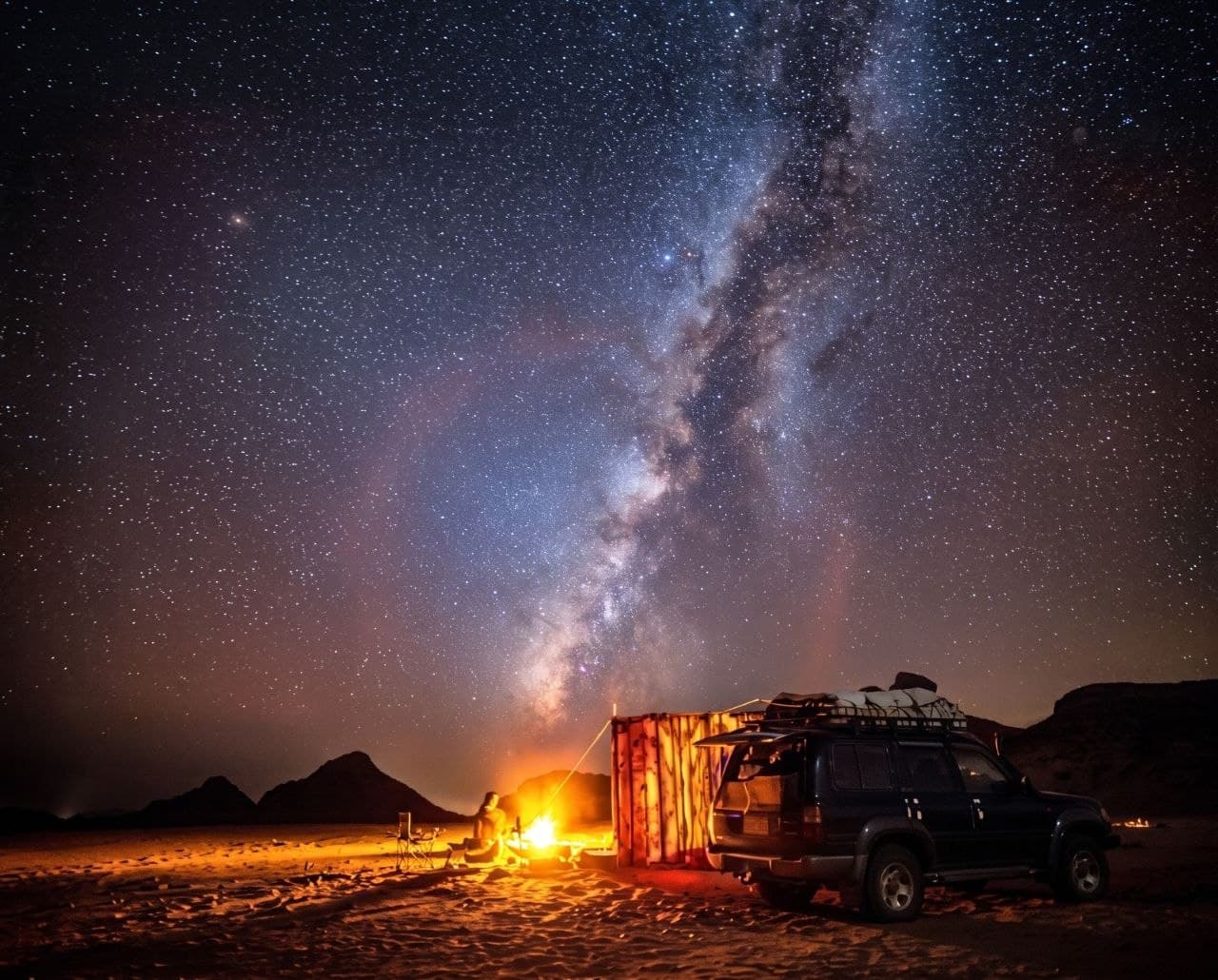
Sky Canvas: A Complete Guide to Astrotourism and Stargazing in the White Desert
Astrotourism is growing rapidly worldwide, yet few places on Earth offer skies as pristine as Egypt's Western Desert. Free from light pollution, the White Desert delivers a night sky so clear that the Milky Way is visible to the naked eye. When you book a private safari with Bedouin Trails, the sky above you transforms into a celestial canvas unlike anything you've ever seen. In this comprehensive guide, we'll take you on a journey to discover the magic of the night sky in the White Desert and how to make the most of this enchanting experience.
What Is Astrotourism and Why Is the White Desert the Ideal Destination?
Unlike conventional attractions that focus on geography and historical buildings, astrotourism focuses on celestial phenomena and observing the universe. The White Desert, hundreds of kilometres from the urban glow of Cairo, offers exceptionally dark skies ranked among the best globally on the Bortle Scale. What makes it truly unique isn't just the dark sky — it's the landscape below. The giant white chalk formations sculpted by wind act as natural reflectors of moonlight and starlight, creating an ethereal, surreal atmosphere. Imagine walking among these luminous white rocks beneath a thick canopy of stars — it feels like walking on the surface of the Moon.
If you'd like to experience this firsthand, you can book a 2-day camping trip in the Black and White Desert or a full 3-day camping trip for up-close stargazing.
Best Timing for Stargazing and Milky Way Photography
Timing your trip around the lunar cycle is crucial for capturing the Milky Way in its full glory and seeing faint stars and meteors.
- New Moon phase: The absolute best time for deep-sky observation and galaxy photography. With the Moon completely absent, the faintest stars emerge and the Milky Way's spiral arms become clearly visible to the naked eye.
- Full Moon phase: Stars are much fainter due to bright moonlight, but this phase has its own magic. The chalk formations glow intensely in the White Desert as if they were giant lanterns, eliminating the need for artificial camp lights and letting you walk at night and see your shadow clearly on the sand from moonlight alone.
Essential Equipment for Professional Astrophotography
Whether you're a professional photographer or an enthusiast passionate about night-sky photography (Astrophotography), proper preparation is key.
- Tripod: A sturdy tripod is essential to prevent camera shake during long exposures.
- Wide-angle lens: Use a wide-angle lens with a fast aperture (f/2.8 or wider) to capture as much light as possible. Cameras with good high-ISO performance will make a significant difference.
- Extra batteries: Desert nights can be bitterly cold, especially in winter, and camera batteries drain rapidly. Bring spares and keep them warm in your inner pockets.
Our guides always share professional tips with photographers to ensure your session runs smoothly through the night.
The Depth of Bedouin Culture and Hospitality
No desert journey is complete without immersing yourself in the local culture. The Bedouin are the original inhabitants of these vast lands, possessing knowledge passed down through generations about every rock, every star, and every plant in the desert.
Your trip with our guides isn't merely a scenic tour — it's an opportunity to learn from true experts in the arts of survival and coexistence with nature's harshest conditions. You'll learn how they navigate by the stars, how they read animal tracks in the soft sand, and how they use desert plants in traditional medicine.
In the evening, around the campfire, the essence of Bedouin hospitality shines. You'll be served traditional Bedouin tea brewed slowly over embers, and your guides will share their stories and inherited legends. These moments of authentic human connection are what keep our guests coming back — they don't feel like tourists, but like honoured guests in a home whose only roof is the sky.
Why Are Private Tours the Best Choice?
When planning a safari trip in the Western Desert, travellers face a key decision: join a group tour or book a private one. At Bedouin Trails, we specialise exclusively in private tours, for several fundamental reasons that directly affect the quality of your experience:
Complete Privacy and Tranquillity
The desert is a place for silence and reflection. In group tours, you're combined with strangers whose schedules, interests, and noise levels may differ from yours. A private tour means the entire camp is dedicated to you and your group alone. You can choose to enjoy the absolute silence of the desert or have quiet conversations with your family and friends without any outside disturbance.
Flexibility of Pace and Schedule
Group tours follow a strict schedule — 15 minutes here, 20 minutes there. If you find a view that takes your breath away and want to stay for an hour to photograph it, you can't because the group must move on. On a private tour, you control the pace. You can spend extra time at Crystal Mountain, skip a stop that doesn't interest you, or request a stop mid-route just to enjoy a sand dune view.
Personal Attention and Service Quality
When the team is working with one vehicle and one group, the level of service rises dramatically. Your guide will share personalised stories tailored to your interests — whether geological, cultural, or photographic. Dietary requirements are met with great care. This bespoke experience (Bespoke Experience) transforms the trip from a mere tourist excursion to an exclusive, supremely comfortable exploration journey.
Weather and Best Times to Visit
Egypt's Western Desert has an extremely arid continental climate with large temperature swings between day and night and across seasons. Understanding this climate is key to planning a successful, comfortable safari.
- Autumn (October–November): One of the best times to visit. Daytime temperatures are moderate (25–30 °C), making rock-formation exploration and long walks enjoyable. Nights cool down pleasantly (10–15 °C) — ideal for sitting around the campfire with warm Bedouin tea.
- Winter (December–February): Sunny and pleasant days (18–22 °C), but nights can be very cold, near freezing deep in the open White Desert. This season is perfect for those who don't tolerate heat but requires proper clothing and cold-weather sleeping bags (which we provide at Bedouin Trails).
- Spring (March–May): Similar to autumn in daytime moderation, but may see "Khamsin" sandstorms — hot, sand-laden winds that can affect visibility and make open camping challenging on some days. Clear spring days, however, are magical and some rare desert plants bloom.
- Summer (June–September): Temperatures soar well above 40 °C in shade during the day. Tourism at this time requires extreme caution and schedule adjustments (moving only in early morning and before sunset). Summer nights, however, are moderate, pleasant, and ideal for stargazing without heavy clothing.
The Complete Packing Guide
Preparing for a desert trip is very different from packing for a beach holiday or city break. The desert is an extreme environment that requires smart layered clothing and gear.
1. Appropriate Clothing
- Daytime: Breathable natural fabrics (cotton and linen). Choose long-sleeved shirts in light colours to reflect sunlight and protect your arms. Loose, lightweight trousers are far better than jeans, which absorb heat and restrict movement.
- Evening and night: As soon as the sun sets, you'll feel the difference. You'll need thermal underwear, a fleece jacket, a windbreaker, and in winter add a beanie, gloves, and thick wool socks to keep your extremities warm while sleeping.
2. Footwear and Head Protection
- Closed-toe, light hiking boots or comfortable trail shoes to protect your feet from hot sand and sharp rocks in the Black Desert and Crystal Mountain.
- A wide-brimmed hat for shade, or you can buy the traditional Bedouin shawl (keffiyeh) from the oases — excellent for sun and sand protection.
- High-quality polarised sunglasses to protect your eyes from the intense glare of the white sand.
3. Essential Gear and Personal Comfort
- Power bank (at least 10,000 mAh) — there are no electrical outlets deep in the desert.
- SPF 50+ sunscreen, lip balm, and moisturiser — the dry air affects your skin quickly.
- Wet wipes (preferably biodegradable) and hand sanitiser — running water is unavailable at desert camps.
- Headlamp — for moving freely around camp at night while keeping your hands free.
What Bedouin Trails Provides
To keep your luggage light, we provide all heavy camping equipment: sturdy Bedouin tents, thick comfortable sleeping mattresses, high-quality sleeping bags suitable for low temperatures, extra clean blankets, all meals, cooking equipment, and clean mineral water throughout the trip.
Our Commitment to Sustainable Tourism (Leave No Trace)
The Western Desert, especially the White Desert National Park, is an extremely fragile environment. The chalk formations that took millions of years to form can be destroyed in seconds through irresponsible behaviour. At Bedouin Trails, we recognise that we are guardians of this land, and we apply strict principles of sustainable ecotourism.
- Leave No Trace policy: We ensure that everything we bring into the desert comes back with us. All waste — organic and non-organic — is collected in dedicated bags and transported to proper disposal sites in Cairo or the Bahariya Oasis. We strictly prohibit leaving any plastic or glass waste at camping sites.
- Respecting wildlife: The desert is home to rare creatures like the fennec fox. We prohibit feeding wild animals or leaving food scraps for them, as this changes their natural behaviour and makes them dependent on humans, threatening their survival.
- Responsible driving: Sticking to designated driving routes is vital to protect rare desert vegetation and prevent soil erosion. Our experienced Bedouin drivers know the safe routes that avoid destroying desert plant roots or crushing delicate rock formations. By choosing us, you're contributing to protecting this natural heritage for future generations.
FAQ
Do I need a telescope for stargazing in the desert?
Not necessarily. The sky in the White Desert is so dark that you'll see thousands of stars and the Milky Way clearly with the naked eye. However, if you own binoculars or a small telescope, bringing them will add exceptional enjoyment for viewing lunar craters and planets like Jupiter and Saturn.
Is there any danger from predators at night?
No danger at all. The animals in the Western Desert, like the fennec fox and desert hares, are very shy and flee from humans. Our Bedouin guides choose completely safe camping spots and keep the fire lit as a precautionary and traditional measure.
What is the best month for Milky Way photography in Egypt?
The best time to see the Milky Way core clearly in the Northern Hemisphere is between late spring and early autumn (April to September), combined with choosing new moon nights.
Can I charge my camera or equipment during the trip?
We offer the ability to charge basic devices via inverters connected to our 4x4 vehicle batteries. However, we always recommend bringing your own high-capacity power banks to be completely self-sufficient.