
The Trip of a Lifetime: 13 Days Between the Grand Desert and the Temples of Luxor
There is a particular kind of traveler who comes to Egypt once and spends the rest of their life trying to describe it to people who weren't there. They talk about the pyramids, obviously. They talk about the Nile. But the ones who really struggle to put it into words are the ones who also spent a night in the Western Desert — who watched the White Desert go from gold to pink to a cold, glowing white under a full moon, and then, a few days later, stood in the Hypostyle Hall at Karnak trying to process the sheer scale of what humans built three thousand years before they were born.
Most visitors have to choose. They pick the desert trip or the Nile Valley trip, because two weeks in Egypt sounds ambitious and nobody wants to build their own itinerary from scratch. That's really the only reason the two experiences usually stay separate — not because they don't belong together, but because almost nobody puts them on the same map.
They belong together. If anything, each one makes the other hit harder.
Why the Desert and the Nile Make Sense as One Trip
Egypt's story has always been a story of contrast. The Nile Valley is where Egyptian civilization built itself upward — temples, tombs, dynasties, a documented record stretching back further than almost anywhere on Earth. The Western Desert is where that same civilization stopped. It's the edge of the map, the place ancient Egyptians associated with chaos, the afterlife, and the unknown. Visiting both isn't just seeing "more of Egypt." It's seeing the full shape of how Egyptians understood their own world — order along the river, mystery beyond it.
There's also a practical case for combining them. A trip built entirely around temples, however spectacular, eventually starts to blur — one hypostyle hall after another, one tomb after another. A trip built entirely around desert camping is unforgettable for different reasons, but it skips three thousand years of recorded history that most people genuinely want to see at least once. Putting the two together breaks up the rhythm in a way that makes both halves land harder. You arrive in Luxor with sand still in your boots, which somehow makes the temples feel less like a museum exhibit and more like something you walked into.
What 13 Days Actually Looks Like
A journey like this isn't a checklist tour where you're herded from site to site with a flag-waving guide. It's built in two clear movements, each with its own pace.
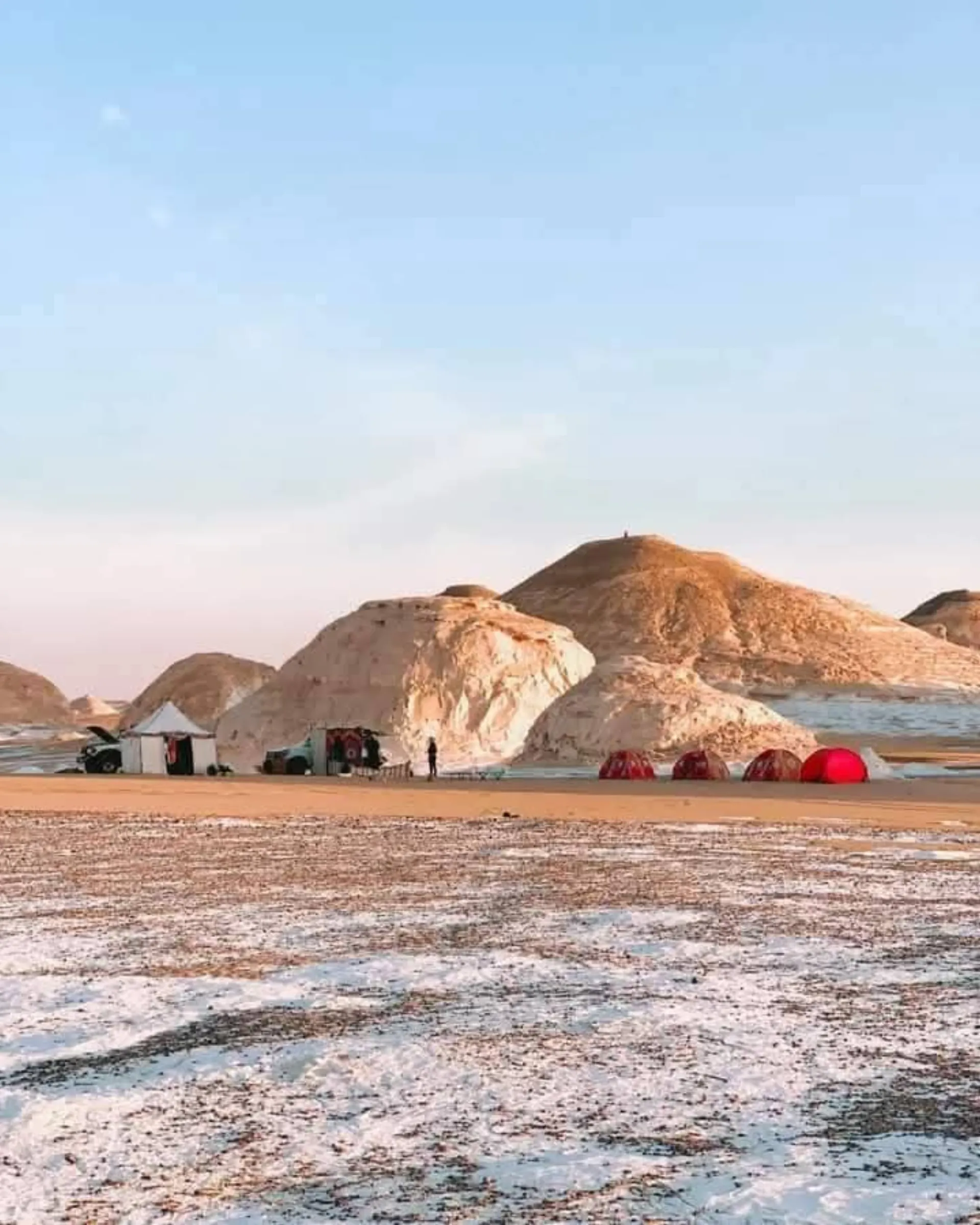
The desert movement usually opens the trip. You head out from Cairo into the Western Desert, through landscapes most travelers have never even heard of before researching Egypt seriously: the chalk formations of the White Desert that look like something sculpted by a giant with too much time on their hands, the volcanic black hills of the Black Desert, oasis towns where life has barely sped up in a century. You sleep in the open — or close to it — under skies with almost no light pollution. You eat food cooked over a fire by people whose families have navigated this terrain for generations, not guides reading from a script. This part of the trip runs on a slower clock. Nobody is rushing you between stops because there often isn't a "next stop" scheduled within the hour. There's just the desert, and time to actually be in it.
The Nile and Luxor movement is the other half, and it runs at a completely different rhythm — layered, historical, detail-heavy. Karnak Temple alone deserves a half-day, not a rushed hour between a bathroom break and a gift shop. The Valley of the Kings, the Colossi of Memnon, the temples of Luxor and Karnak at sunset when the stone turns the color of honey — this is where Egypt's written history stops being an abstraction in a textbook and becomes something you're standing inside.
Thirteen days gives you room to do both without feeling rushed through either. It's enough time in the desert to actually settle into it — two or three nights, not a single frantic overnight — and enough time around Luxor to see the major sites properly instead of ticking them off a list at a half-jog.
Who This Trip Is Actually For
This isn't a trip for someone who wants a beach chair and a cocktail with an umbrella in it. It's for people who get genuinely restless on standard package tours, who'd rather spend an afternoon learning how a Bedouin guide reads the desert than lounging by a hotel pool. It suits travelers planning what might be their only trip to Egypt and who don't want to come back in five years wishing they'd seen "the other half." It also suits more experienced travelers who've already done a shorter Nile cruise or a quick desert overnight and are ready for the fuller version — the one that actually connects the dots between Egypt's ancient history and its living desert culture.
Physically, it's moderate. You don't need mountaineering experience. You need a reasonable tolerance for early starts, some walking on sand, and a willingness to sleep somewhere without wifi for a few nights. In exchange, you get a version of Egypt that most visitors — even repeat visitors — never actually see in one trip.
A Few Honest Things to Know Before You Book
Thirteen days is a real commitment, and it's worth going in with clear expectations. Temperatures swing hard between day and night in the desert, especially outside the summer months, so layering matters more than most people assume packing for "Egypt" in general. Some stretches of desert driving are long — this is a big country, and distances between oases aren't small. And because the trip moves between two very different environments, flexibility matters more than it would on a single-region itinerary; weather, road conditions, and seasonal factors can shift a day's plan, and the trips that work best are the ones where travelers come in ready to adapt rather than demanding a minute-by-minute script.
None of that is a downside, exactly. It's just the honest texture of a trip this ambitious — and most people who book it say afterward that the parts that felt unpredictable in the moment were the parts they remember best.
When to Go
Timing matters more on a trip like this than on a single-region itinerary, because you're asking two different environments to both be at their best within the same window. The sweet spot is roughly October through April. Daytime desert temperatures are comfortable rather than punishing, nights are cold but manageable with proper layering, and Luxor's temples — which can be brutal under the open sun in midsummer — are far more pleasant to walk around for hours at a time. December and January bring the coldest desert nights of the trip, so pack accordingly if you're traveling then. Shoulder months like October and April tend to offer the best balance: warm enough days, bearable nights, and slightly thinner crowds at the major Luxor sites compared to the peak of winter. Summer isn't off the table entirely, but the combination of extreme Nile Valley heat and genuinely cold desert nights makes it the least forgiving option for a trip this long.
The Version of Egypt Most People Never See
Everyone who goes to Egypt sees the pyramids. Most people who go to Egypt see a Nile cruise. Fewer people see the desert at all, and almost nobody sees both halves on the same trip, built as one coherent journey rather than two separate bookings stitched together after the fact.
That's really the appeal here. It's not "more Egypt" for the sake of volume. It's the version of the country that actually makes sense once you've seen it — the order of the temples and the vast, indifferent space beyond them, the two things ancient Egyptians spent three thousand years thinking about in relation to each other.
See the full 13-day Grand Egypt Desert & Oases itinerary — Book the 13-day journey now
If 13 days feels like more than you have room for right now, the shorter 8-Day Egypt Adventure Journey covers the same essential contrast — desert and Luxor — in a tighter window, and makes a solid first step toward the longer trip down the line.
FAQ
Is 13 days too long for one trip to Egypt?
Not at all. Thirteen days gives you enough time to experience both the Western Desert and Luxor without rushing through either. Most travelers say afterward that they wished they'd had even more time.
Can I do a shorter version of this trip?
Yes. The 8-Day Egypt Adventure Journey covers the same essential contrast — desert and Luxor — in a tighter window. It's a great first step if 13 days feels like more than you can commit to right now.
What is the best time of year for this trip?
October through April is the sweet spot. Desert days are comfortable, nights are cold but manageable, and Luxor's temples are far more pleasant to explore without the extreme summer heat.