
One Night in Egypt's White Desert: The Camping Rituals That Reset Your Priorities
One camping night in Egypt's White Desert isn't just an outdoor sleepover. Most visitors say it's the single most transformative moment of their entire trip — the one moment where they stop and ask themselves: when was the last time I truly disconnected from everything? When was the last time I didn't have to be anywhere else? In this article, we walk you through the six rituals that make a White Desert camping night fundamentally different from any other experience, and why so many guests return to live it again and again.
Ritual 1: Choosing the Campsite — An Art the Untrained Eye Can't See
Before a single tent goes up, the Bedouin guide reads the land with eyes that have inherited generations of knowledge. He isn't simply looking for flat ground; he's searching for a wind-sheltered spot that still holds an open horizon wide enough to contain both sunset and a full sky of stars. He avoids low-lying areas where cold moisture collects after midnight, and gravitates toward large chalk formations that break the wind without blocking the view. What looks like a casual stop to a first-time visitor is actually a deliberate decision rooted in centuries of living specifically on this land. The result? A deeper sleep and a more breathtaking sunrise.
Ritual 2: Setting Up Camp — Between Speed and Ceremony
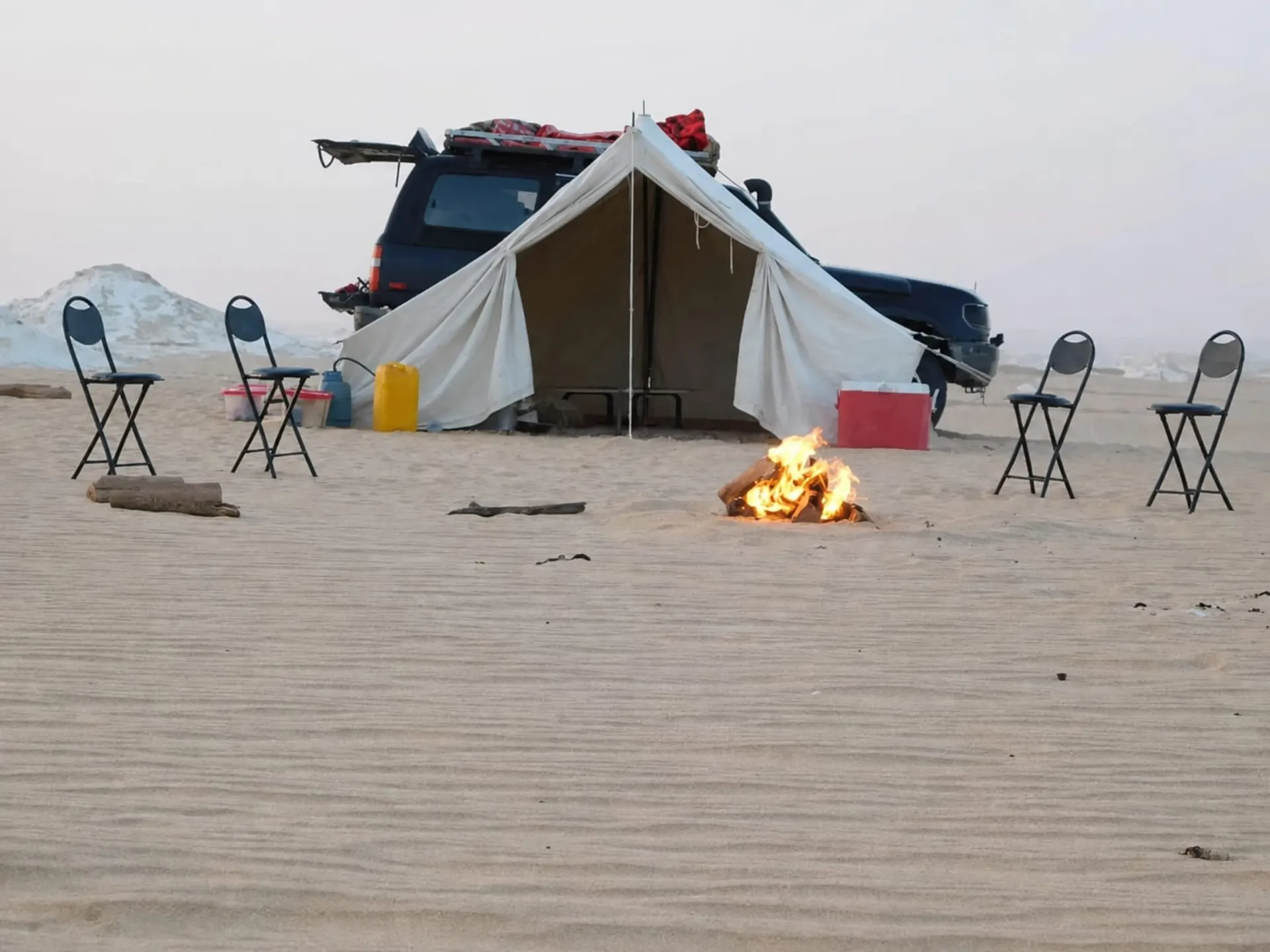
The guide team barely speaks while setting up camp. Everyone knows their role, every movement is purposeful, and each step precedes the next with a precision that reveals a silent coordination built through repetition rather than instruction. Tents rise, the table is arranged, bedding is laid out, firewood is stacked — all in a timespan that seems almost implausible to a first-time observer. What makes this ritual deeper is that you can join it; pitching your own tent with the guide's help builds an entirely different relationship with the place you're about to sleep in, as though you're staking a temporary, personal claim on this small patch of vast desert.
Ritual 3: Waiting for Sunset — The Moment That's Never Rushed
No schedule forcing you to move, no appointment waiting, no notification demanding your attention. The white chalk formations begin their slow color journey almost imperceptibly: first a barely believable pale pink, then a warming orange that gradually ignites into something fiery and arresting. The sky shifts from pale blue into the depths of violet and indigo. Most guests put their phones away after the first few photos — not because phones are discouraged, but because they suddenly realize they don't want to spend this moment behind a screen. Sunset in the White Desert is not a scene you watch; it's something you inhabit while standing at its center.
Ritual 4: Lighting the Fire — The Social Gravity Center of the Night
The fire in Bedouin camping isn't only for warmth; it's the axis everything naturally orbits. Traditional Bedouin tea is prepared slowly, deliberately, on the glowing embers — and the time it takes is not a delay but part of the ritual itself, each round of tea an invitation to slow down and be present. The guides share stories inherited from their fathers and grandfathers: about the stars and how they were used to navigate the desert before any map existed, about specific rock formations tied to legends that have traveled these plains for centuries, about winter crossings no one remembers except the families who made them. Guests often describe this portion of the night as the most human, most intimate part of the entire trip.
Ritual 5: Absolute Stillness — When Silence Becomes Audible
After dinner and stories, the deepest ritual of the night begins: silence. Zero light pollution, zero human noise, no engines on any horizon. The Milky Way is visible to the naked eye with a clarity that feels almost impossible — a wide silver curtain stretched directly overhead. Thousands of stars invisible from any electrically lit city appear here as though drawing closer the longer you look. Many guests describe this moment as near-spiritual, saying it reset their understanding of what actually matters in their daily lives. Sleep comes deeply and with unusual speed, wrapped in sleeping bags engineered for desert cold, with the soft sound of wind moving between chalk formations pulling the curtain down on an exceptional day.
Ritual 6: Waking to Sunrise — The Ritual Ends Where It Began
No alarms in the desert; only the gentle warmth of the rising sun filtering slowly through tent fabric, coaxing you awake after hours of the deepest sleep many guests report having in years. Stepping out of the tent in the first minutes after dawn reveals a world that has transformed overnight: the same chalk formations that blazed orange yesterday now glow in a quiet rose-gold, and the air carries a purity that makes every breath feel like the first one. Watching sunrise over the White Desert after having spent the night among its formations gives you a feeling of circular completeness — as though you didn't visit a place, but lived in it long enough to understand it from the inside.
What Makes a "Perfect Camping Night" Practically?
Desert night temperatures can drop sharply after sunset, even in autumn and spring. This means sleeping bag and mattress quality aren't a detail — they directly determine your comfort level and, by extension, how deeply you experience everything else. At Bedouin Trails, we use cold-rated sleeping bags engineered to handle low overnight temperatures, paired with thick mattresses that insulate you from the cold radiating up from the ground. Tents are spaced far enough apart to give each guest genuine privacy, while remaining close enough to the central fire to feel the warmth and hear the conversation when you want it. The result: solitude when you need it, and connection when you seek it.
Does the Camping Ritual Change by Season?
Yes, and every season carries its own distinct magic. In autumn and winter, from October through February, the fireside evenings stretch longer — more stories, more rounds of tea, more warmth of gathered company against the cold. The night is longer and the chill makes the fire more magnetic, more intimate. In summer, fire sessions are shorter, but the sky is often clearer, and the evenings end early to make way for a different ritual: lying flat on your back directly beneath the open sky, eyes wide to a canopy of stars, without needing heavy blankets. Both seasons offer complete experiences, simply in different tempos.
How to Experience These Rituals Yourself
If you're ready to discover all six of these rituals firsthand, we have two trips designed precisely for this experience. You can set out on the 2-day Black & White Desert camping trip for one full camping night that takes you through every ritual described here. Or, if you want to live the camping rituals across multiple nights in more varied terrain, the 7-day Western Desert camp offers a far deeper immersion into this extraordinary world.
One night may seem like "just another camping addition" on paper. But those who've lived it know it resets your internal clock and reminds you of a slower, more authentic rhythm of being. Book your night in the White Desert and let the silence and stars do what no other place on earth can.
FAQ
Is camping safe for families with children?
Yes — the camps are fully equipped and monitored by an experienced team throughout the night, and are suitable for children accustomed to a reasonable level of outdoor activity.
What if I get too cold at night?
We provide extra blankets and cold-weather sleeping bags on request, and our team is present all night to respond to any need.