
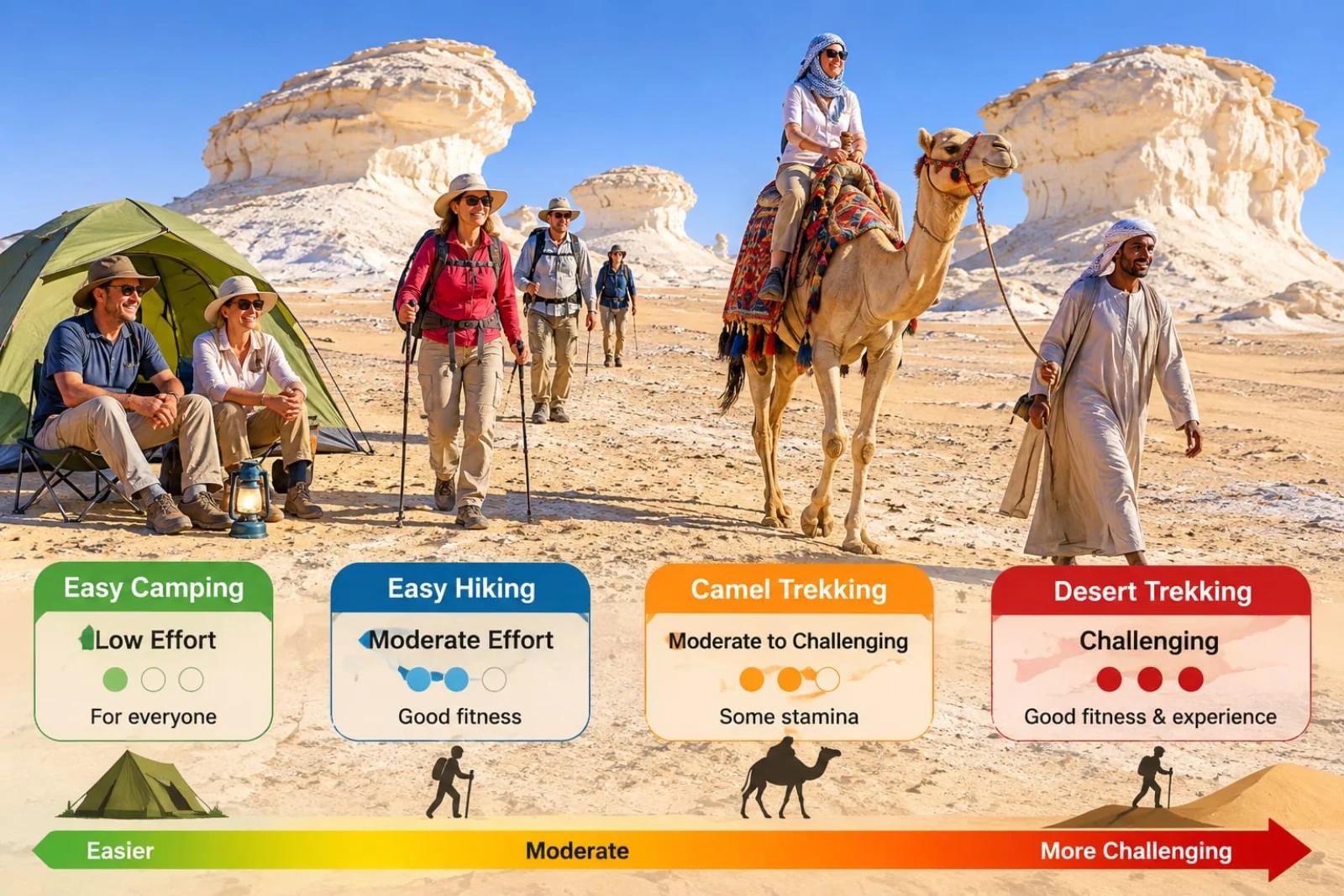
How Hard Is It? Fitness Levels for White Desert Hiking, Camel Trekking & Camping Tours
"Is camel trekking hard?" "Do I need to be fit for a desert hiking tour?" "Can my parents handle a White Desert trip?" These are some of the most common questions we get from travelers researching a White Desert Egypt Tour, and they rarely get a straight answer online — most tour pages describe scenery, not stamina. This guide breaks down exactly how demanding each style of trip is, so you can match your booking to your actual fitness level rather than guessing from a brochure photo.
Why Difficulty Varies So Much on the Same Trip Type
The White Desert isn't one experience — it's a destination you can visit at almost any activity level, from barely leaving the vehicle to walking ten-plus kilometers a day under a desert sun. The confusion usually comes from marketing that uses "safari" and "adventure" loosely across very different itineraries. A 4x4-based Egypt Desert Safari with short photo stops and a two-day White Desert Camping Tour that includes a half-day walk are not the same physical commitment, even though both get marketed with near-identical language. Knowing which category your itinerary actually falls into is the first step.
Easy: A Classic 2-Day White Desert Camping Tour
This is the most popular entry point, and it's genuinely accessible to most people in reasonable general health, including older travelers and families with children. You're in a 4x4 for the bulk of the journey, with short walks — usually under a kilometer at a time — to viewpoints, rock formations, and the camp itself. The main physical factors are heat, dust, and a bumpy ride over unpaved terrain, not exertion. If your concern is whether you can "handle" the White Desert at all, this is the tier to start with.
Moderate: Half-Day Walks and a Bahariya Oasis Safari
Step up slightly and you're looking at itineraries that combine 4x4 transport with a half-day of walking — across dune fields, around the black desert's volcanic hills, or through parts of a Bahariya Oasis Safari that include a walk to hot springs or English Mountain. Expect two to four kilometers of walking across loose sand and gentle inclines, spread through the day rather than in one continuous stretch. A moderate baseline fitness — comfortable walking for 30-45 minutes without needing to stop — covers this tier easily.
Challenging: A Multi-Day White Desert Hiking Tour
This is where things change meaningfully. A dedicated White Desert Hiking Tour, run over five or eight days, typically covers 10-15 kilometers a day on foot, carrying a day pack, across sand, gravel, and rock in temperatures that can swing from warm midday sun to near-freezing desert nights. You'll want a solid base of regular walking or hiking fitness beforehand — this isn't a trip to attempt as your first time exercising in months. Good footwear, broken in before you arrive, matters more here than on any other tier.
Egypt Camel Trekking: A Different Kind of Demand
Egypt Camel Trekking doesn't require leg stamina the way hiking does, but it tests you differently — balance, core strength, and tolerance for hours in the saddle. Most first-day riders feel sore in the inner thighs and lower back by evening; by day two or three, most people adjust. Routes vary from a few hours as part of a broader itinerary to multi-day camel expeditions where you're in the saddle for five or six hours daily, walking alongside the camel on some stretches to rest. If you have lower back issues or very limited riding experience, ask your operator about shorter camel segments rather than committing to a full multi-day trek straight away. Physical effort aside, where and how you sleep after a long day in the saddle matters too — see our comparison of luxury vs classic White Desert camping for what each camp setup actually offers.
Why a Private Desert Safari Egypt Lets You Set Your Own Pace
One factor that changes the difficulty equation entirely: whether you're on a fixed group itinerary or a Private Desert Safari Egypt. On a private trip, your guide can adjust walking distances, add rest stops, or swap a hiking segment for a shorter 4x4 detour — something that's much harder to arrange mid-trip on a shared departure with a fixed schedule. If you're traveling with a mixed-fitness group, such as grandparents and teenagers, or if you have a specific physical limitation, a private booking is usually the more comfortable route. This is exactly the kind of flexibility worth confirming before you book — our guide on vetting a White Desert tour operator covers the questions to ask.
Difficulty at a Glance
| Trip style | Daily walking | Terrain | Fitness needed |
|---|---|---|---|
| 2-day camping (4x4-based) | Under 1 km | Flat stops, short viewpoints | Minimal |
| Half-day walks / oasis stops | 2-4 km | Sand, gentle slopes | Moderate |
| Multi-day hiking tour | 10-15 km | Sand, gravel, rock | Good baseline fitness |
| Camel trekking | Variable | Saddle time + walking stretches | Core strength, saddle tolerance |
Who Should Choose a Gentler Egypt Desert Safari
If you're traveling with young children, older relatives, or anyone with joint issues, heart conditions, or limited mobility, the 4x4-based camping itineraries remain the most comfortable way to see the White Desert's main highlights without the physical demands of hiking or extended camel riding. Heat sensitivity matters too — if you struggle in hot climates generally, consider traveling in the cooler months (November through February) regardless of which tier you choose. For more on seasonal planning, our guide on the best time to visit Egypt's desert covers month-by-month conditions in detail, and our safety guide addresses heat, hydration, and general health precautions.
How Bedouin Trails Matches You to the Right Itinerary
We ask about fitness level and any physical limitations before confirming a booking, not after you've arrived — it's a better way to avoid mismatched expectations on either side. For travelers who want the full walking experience, our 5-day desert hiking program and 8-day desert hiking program are built for a solid hiking fitness base. If camel trekking is the draw, our 5-day White Desert camel trekking and camping expedition and longer 8-day camel program are paced with rest and shorter riding blocks built in. And if you'd rather start gently, our 2-day camping trip remains the easiest way to see the White Desert's core landscape.
Related Reading
Fitness is only one piece of planning the right trip. Once you know which difficulty tier fits you, our guide on choosing a White Desert tour operator covers what to ask before you book, and our comparison of luxury vs classic camping helps you decide how comfortable you want your nights in camp to be.
Veelgestelde Vragen
Is camel trekking painful for beginners?
Mild soreness in the first day or two is common, especially in the inner thighs and lower back. It typically eases as your body adjusts. Shorter rides, good saddle padding, and breaks to walk beside the camel all reduce this.
How fit do I need to be for White Desert hiking?
You should be comfortable walking 8-10 kilometers over uneven terrain without significant strain. Regular walking, hiking, or general cardio fitness in the weeks before your trip makes a real difference.
Can older travelers or young children join a desert safari?
Yes, on the 4x4-based camping itineraries, which involve minimal walking. Multi-day hiking and extended camel trekking are better suited to healthy adults and older teens.
What if my group has very different fitness levels?
A private safari is the easiest solution — your guide can tailor walking distances and riding time to the least fit member of the group without changing the itinerary for everyone else.
Does the heat make these trips harder?
Yes, more than most people expect. Midday temperatures in warmer months can make even moderate walking feel strenuous. Traveling November through February significantly reduces this factor across every difficulty tier.