
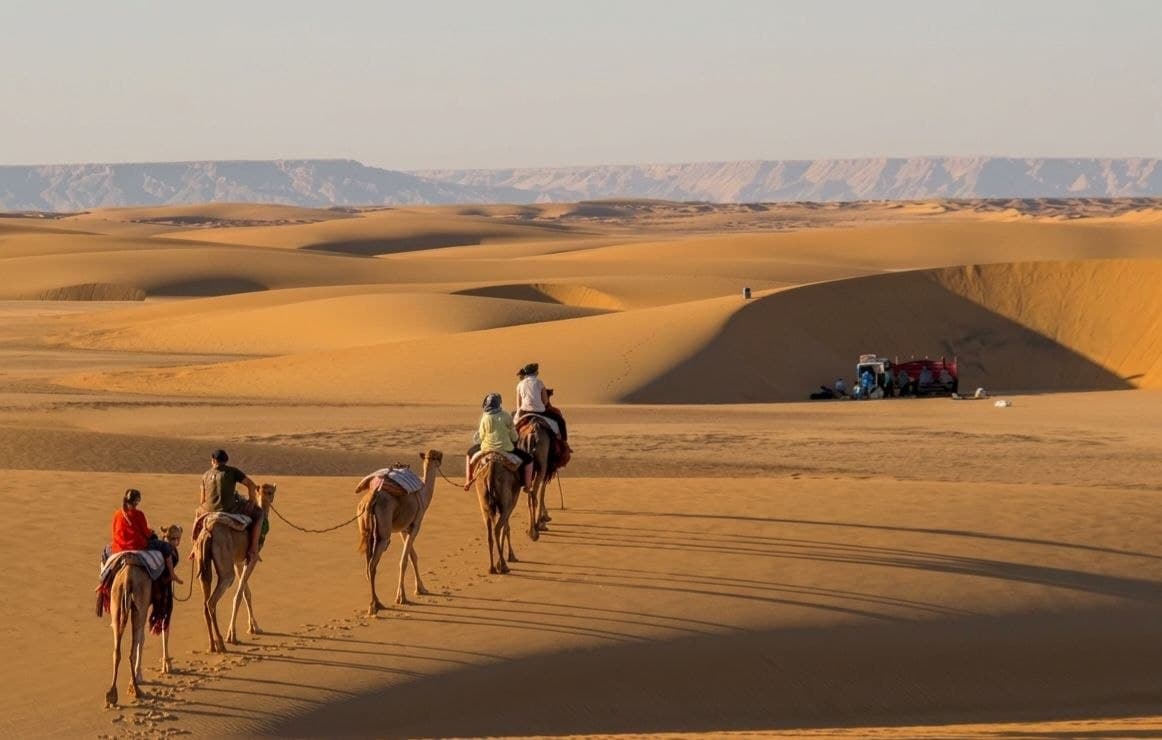
Eight Days on a Camel: What It Actually Takes to Live Like the Desert's Original Travelers
Most desert trips in Egypt use camels the way most trips use any other vehicle — a short ride for photos, maybe an hour at sunset, then back into the 4x4 for the real distance. There's nothing wrong with that. It's a reasonable way to get a taste of something without committing a week of your life to it. But it's also a fundamentally different experience from what camels were actually for, for thousands of years, across this landscape: not a photo prop, but the only way anyone crossed this desert at all.
An eight-day camelback journey is built around recovering that older relationship — not simulating it for an afternoon, but actually living inside it long enough that it stops feeling like an activity and starts feeling like simply how you're traveling.
Why Eight Days Specifically
A one-hour camel ride teaches you almost nothing about camels except that they're tall and the saddle takes some getting used to. A full day teaches you that your body needs real adjustment — the particular ache in muscles you didn't know you used for balance, the rhythm you eventually fall into once you stop fighting the animal's gait and let it carry you instead of bracing against it.
It's really around day three or four that something shifts. The soreness that defined the first two days starts to fade as your body adapts. You stop thinking about the mechanics of staying balanced and start noticing the landscape changing around you instead — the particular way a camel's elevated vantage point changes what you see and how far you see it. By day five or six, the rhythm of the trip itself takes over: wake with first light, walk through the cooler morning hours, rest through the worst of the midday heat, walk again as the light softens toward evening, camp, repeat. That rhythm is the actual point of an eight-day trip — it's long enough to stop being a novelty and start being simply how your days work, which a one- or two-day version never has time to become.
What the Days Actually Look Like
Mornings start early, often before full sunrise, because camels and their handlers both work better in the cooler hours and because watching the desert color shift at dawn from camelback is reliably one of the trip's best moments. The pace is unhurried by design — a camel's natural walking speed is around four to five kilometers an hour, which sounds slow until you realize it's exactly fast enough to actually watch the landscape change rather than blur past it.
Midday is for rest, usually in whatever shade the terrain offers — a rock outcrop, a stand of acacia, sometimes nothing more than a strip of shadow cast by the animals themselves. This is when most of the trip's real conversation happens, between travelers and with the Bedouin guides who've spent their lives reading this terrain in ways no guidebook captures. Afternoons bring a second walking stretch before the light turns gold, and evenings end around a fire, with a meal cooked over it and a sky that, this far from any city, shows more stars than most travelers have ever actually seen at once.
The Bedouin Knowledge That Makes This Possible
None of this works without guides who've grown up reading this landscape — knowing which wells still hold water this time of year, how to read weather shifts before they arrive, which routes a camel train has used for generations because they're simply the ones that work. This knowledge doesn't come from a training manual; it's accumulated across lifetimes and passed down inside families who've lived alongside this desert, not just visited it.
Spending eight days with that kind of guide means the difference between seeing Bedouin life from a respectful distance and actually being folded into it for a week — sharing meals the way they're actually eaten out here, learning how a camp gets set and struck efficiently, picking up the handful of practical skills that make the difference between struggling with a stubborn animal and simply working with one. Travelers curious about that broader context will find useful background in our piece on Bedouin culture in the Egyptian desert.
Preparing Your Body (and Your Expectations)
Honesty matters here: the first two days are genuinely uncomfortable for almost everyone, regardless of fitness level. Camelback uses muscles — particularly through the hips, inner thighs, and lower back — that even regular runners or cyclists rarely engage the same way. Expecting that discomfort rather than being blindsided by it makes a real difference; most trips are structured with shorter riding stretches in the first two days specifically to let bodies adjust before the longer stages later in the week.
Clothing matters more than people expect too — loose, breathable layers that cover skin from sun exposure, with specific attention to anything that might chafe against the saddle over multiple hours. For travelers who want a fuller grounding in what camel travel actually involves before committing a full week to it, our camel safari guide to Egypt covers the practical essentials — pacing, gear, and realistic expectations — that make the difference between an eight-day trip you remember fondly and one you spend mostly counting down.
Who This Trip Actually Suits
An eight-day camelback journey isn't the right fit for every traveler, and it's worth being honest about that before booking. It suits people who genuinely want to disconnect — no charging stations, limited or no phone signal for most of the route, and a pace that makes checking email or scrolling a feed simply impossible rather than merely inadvisable. It also suits travelers who are reasonably comfortable with physical discomfort as part of an experience rather than something to be engineered out of it entirely; this isn't a trip for anyone expecting hotel-level comfort at the end of each day.
It tends to appeal most to travelers who've already done a shorter desert trip — a day safari, maybe a two- or three-day camping trip — and come away wanting more of exactly that feeling rather than less. For a first-ever desert experience, a shorter trip is usually the better entry point; the eight-day version rewards people who already know they want this particular kind of slow, immersive travel and are ready to commit a full week to it.
What You Actually Take Away From It
Ask anyone who's done a multi-day camel trek what stays with them, and it's rarely a single dramatic landmark. It's the accumulated rhythm — the specific quality of silence that only exists this far from any road, the sky at night once your eyes fully adjust to the dark, the particular bond that forms with an animal you've spent a week learning to move with rather than just sit on. It's slower than almost any other way to see the desert, and that slowness is exactly the point: eight days is long enough to stop treating the journey as something you're doing and start experiencing it as simply where you are.
Domande Frequenti
How physically demanding is an eight-day camel trek?
The first two days are the hardest — expect soreness in your hips, inner thighs, and lower back regardless of general fitness level. Most trips structure shorter riding stages in the opening days to let your body adjust before longer stretches later in the week. By day three or four, the acute discomfort fades and most travelers find their rhythm. Appropriate clothing that won't chafe against the saddle makes a significant difference.
What does a typical day on an eight-day camel trek look like?
Days start before full sunrise to take advantage of cooler temperatures. The caravan walks at four to five kilometers per hour — slow enough to actually watch the landscape change. Midday is a rest stop in whatever shade is available, which is also when most genuine conversation with guides and fellow travelers happens. A second walking stretch in the afternoon ends at camp, where dinner is cooked over an open fire under a sky with more stars than most people have seen in their lifetime.
Is an eight-day camel trek suitable for first-time desert travelers?
Generally, the eight-day version is better suited to travelers who've already done a shorter desert experience — a day safari or a two- to three-day trip — and want more of that immersive feeling. For a genuine first desert experience, a shorter trip usually provides a better entry point. The eight-day version rewards travelers who already know they want slow, disconnected travel and are ready to commit fully, rather than those sampling it for the first time.